A standstill agreement is a formal contract that essentially acts as a temporary "pause button" on specific actions between parties. This agreement creates a controlled window for negotiation by preventing things like hostile takeovers, halting aggressive debt collection, or suspending legal deadlines.
What Is a Standstill Agreement in Simple Terms
Imagine hitting pause during a high-stakes business deal. That's really the core function of a standstill agreement. It's a formal, legally binding contract where both sides agree to temporarily stop certain actions, creating a safe, controlled space for discussion and strategic planning.
You can think of it like calling a timeout in a crucial sports game—it stops the clock and allows the teams to strategize without the game ending abruptly. This legal "pause" is a powerful tool used to bring order to potentially chaotic situations, giving everyone involved a chance to find a more constructive path forward.
Core Applications of the Business Pause Button
The versatility of this agreement makes it valuable in several very different business and legal situations. Its primary goal is always the same: create temporary stability.
Key applications include:
- Mergers and Acquisitions (M&A): A standstill agreement can prevent a potential buyer from launching a hostile takeover while they have access to a target company's sensitive data for due diligence.
- Debt Restructuring: It provides a struggling company with much-needed breathing room by temporarily stopping creditors from taking aggressive collection actions, like filing lawsuits or seizing assets.
- Legal Disputes: In litigation, it can pause the legal clock on a statute of limitations, giving parties more time to negotiate a settlement outside of court and avoid further legal costs.
This concept map visualizes how a standstill agreement functions as that central 'pause button' across these key business areas.
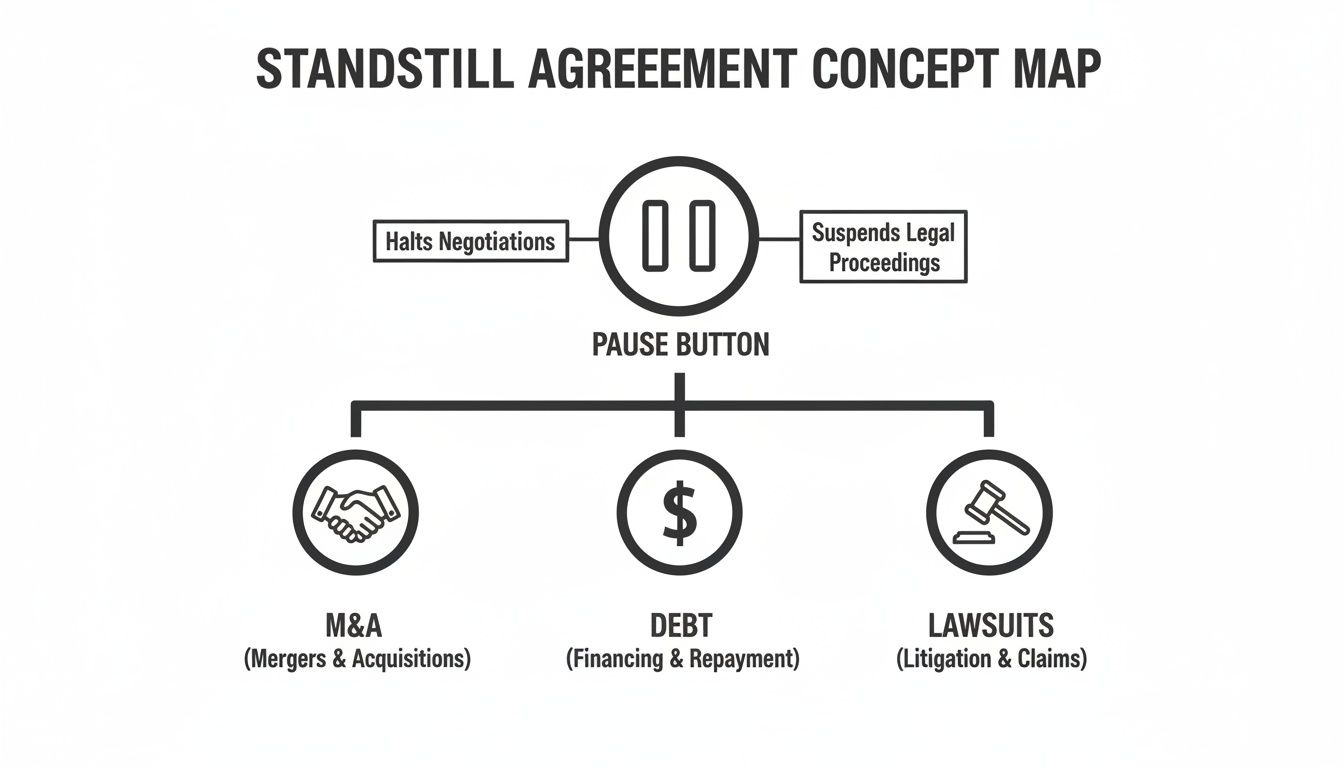
As the visual shows, whether you're dealing with an M&A deal, a debt workout, or a lawsuit, the agreement’s purpose is to halt the action and foster a more controlled negotiation.
Core Functions of a Standstill Agreement at a Glance
To really nail down the concept, this table breaks down how a standstill agreement works in practice across its most common uses.
| Scenario | Primary Function of the Agreement | Who It Protects |
|---|---|---|
| Mergers & Acquisitions (M&A) | Prevents hostile takeovers or unwanted stock accumulation during negotiations. | The target company's board and shareholders. |
| Debt & Restructuring | Pauses creditor collection actions (e.g., lawsuits, foreclosure). | The debtor company trying to reorganize its finances. |
| Litigation | Suspends the statute of limitations to allow for settlement talks. | Both parties, by avoiding costly and protracted court battles. |
By establishing this clear, practical foundation, it's easier to see the purpose of the agreement before we dive into its more powerful applications. In every scenario, this contractual pause is used to de-escalate pressure and work toward a better outcome than immediate, aggressive action would allow.
If you want to discuss your business law matter, contact Kons Law at (860) 920-5181.
How Standstill Agreements Protect Companies in Mergers and Acquisitions
In the high-stakes game of mergers and acquisitions (M&A), information is the ultimate currency. When a potential buyer comes knocking, the target company has to open its books and share incredibly sensitive data—a process we call due diligence. This creates a massive risk: what’s to stop that suitor from taking what they’ve learned and launching a hostile takeover?
This is precisely where a standstill agreement acts as a critical defensive shield. Think of it as a contractual handshake where the potential acquirer promises to play by a certain set of rules for a specific amount of time. By signing, the suitor gets the confidential access they need to evaluate the deal, but they give up the ability to turn that information against the target.
The agreement creates a controlled, good-faith environment for the talks to unfold. It’s the difference between a friendly inquiry and an unwelcome assault.
Preventing Hostile Takeover Tactics
A well-crafted standstill agreement gets right to the point, prohibiting the very actions that could destabilize a company or undermine its board. These restrictions are the heart of its protective power.
Key prohibitions usually include:
- Acquiring More Shares: The suitor agrees not to quietly buy up company stock on the open market, which is a classic move to gain a controlling interest without anyone noticing.
- Waging a Proxy Fight: The agreement stops the potential buyer from trying to rally shareholders to vote out the current board or force a sale.
- Making a Tender Offer: The suitor can’t just bypass the board and make a direct offer to shareholders to purchase their stock.
- Publicly Pushing for a Sale: It also restricts the acquirer from using public announcements or media pressure to corner the target company into a deal.

This legal framework ensures that negotiations stay in official channels, giving the target company's board control over the process and the timeline. Without it, the due diligence process would be far too risky for most companies to even consider. For a deeper dive, check out our mergers and acquisitions due diligence checklist.
By setting these boundaries, the standstill agreement levels the playing field. It allows the target company to share information with confidence, knowing the potential buyer can't immediately weaponize it to launch a hostile bid.
Fostering a Controlled Bidding Environment
A standstill agreement in M&A is a vital defensive tool, with a lifespan that can stretch anywhere from six months to five years, depending on how complex the deal is. Throughout this period, the potential acquirer is effectively sidelined from announcing a public bid, buying more shares, or trying to sway shareholder votes.
This control is absolutely essential. Industry data suggests that approximately 25-30% of public M&A deals that involve confidential due diligence lean on standstill clauses to stop bidders from using sensitive financial data to launch aggressive offers. You can find out more about the role of standstill agreements in M&A deals on dealroom.net.
Ultimately, this structure fosters orderly negotiations, protects shareholder interests, and gives the board the breathing room it needs to secure the best possible outcome. If you want to discuss your business law matter, contact Kons Law at (860) 920-5181.
Using Standstills for Debt Restructuring and Creditor Talks
When a company is on shaky financial ground, the pressure from creditors can feel like a tidal wave. Lenders, understandably anxious about getting their money back, often start to take aggressive actions. A standstill agreement can be a lifesaver in these moments, acting as a crucial safety valve to give a struggling business the breathing room it needs.
Think of it as hitting the pause button. It’s a formal ceasefire where the company and its creditors agree to temporarily halt all enforcement actions. That means no asset seizures, no foreclosure proceedings, and no new lawsuits. This isn't just about kicking the can down the road; it's a strategic move that opens up a window for the company to stabilize, map out a real turnaround plan, or find new financing without the constant threat of being pushed into bankruptcy.

Why Would a Creditor Ever Agree to Wait?
At first glance, it might seem odd for a lender to willingly delay payment. But there’s a solid business case behind it. Smart creditors know that forcing a company into a quick liquidation often triggers a "fire sale" of assets, where they’re lucky to get pennies on the dollar. A successful restructuring, on the other hand, can lead to a much healthier financial recovery for everyone.
By agreeing to a standstill, creditors are essentially making a calculated bet on the company’s potential to bounce back. It gives them a chance to:
- Preserve Asset Value: A company that’s still operating is almost always worth more than one that’s been stripped for parts.
- Negotiate from a Better Position: The pause creates space for structured, rational negotiations that could lead to revised payment schedules or even debt-for-equity swaps—options that are far better than a total loss.
- Get a Clearer Picture: As part of the deal, the debtor company usually has to provide regular financial updates, which gives creditors valuable transparency into what’s really going on.
This collaborative approach can align everyone's incentives toward the same goal: survival and recovery. During these high-stakes talks, it's also critical for everyone at the table to understand potential complications like director liability for company debts.
Paving a Path to Recovery
In a debt context, a standstill agreement is far more than an informal promise; it’s a structured tool that freezes collections. We saw just how vital this was during the 2008 financial crisis when U.S. corporate defaults shot up to 13.6%, allowing countless firms to restructure instead of collapse. In fact, the International Monetary Fund (IMF) found that these agreements were key to a successful recovery in 40% of distressed restructurings in emerging markets between 2010 and 2020.
Ultimately, the agreement buys time—the single most valuable asset in any corporate turnaround. It lets management focus their energy on fixing the core business issues instead of being bogged down in a constant legal firefight. This is especially critical for any secured creditor, whose collateral is directly tied to the company's ability to keep its doors open.
If you want to discuss your business law matter, contact Kons Law at (860) 920-5181.
Pausing the Legal Clock with Tolling Agreements
In the world of legal disputes, time is not on your side. Almost every potential lawsuit is up against a strict deadline called the statute of limitations. If you miss that window, your right to sue disappears—no matter how solid your case is. This is where a standstill agreement, often called a tolling agreement in legal circles, becomes a powerful tool to press pause on that ticking clock.
Think of it as a private contract between potential opponents where they both agree to suspend the statute of limitations for a specific amount of time. It’s a smart, practical move that turns a frantic race to the courthouse into a more controlled environment for negotiation. By signing one, both parties buy themselves precious time without giving up their legal rights.
Creating Space for Constructive Dialogue
So, why would two opposing parties willingly agree to delay a legal deadline? It really comes down to the shared desire to avoid the cost, stress, and damage of a full-blown lawsuit. When a legal fight is brewing, a tolling agreement takes the immediate pressure of a court filing off the table.
This strategic pause creates breathing room for much more productive conversations, like:
- Sharing information voluntarily to get a clearer picture of the strengths and weaknesses on both sides.
- Bringing in a mediator or trying other forms of alternative dispute resolution to find common ground.
- Negotiating a private settlement that can save a business relationship a formal lawsuit would almost certainly destroy.
By removing the imminent threat of litigation, both sides can explore settlement options more freely, saving a ton of time and money in the process. It's a strategic de-escalation that puts resolution ahead of conflict. You can learn more about the specific legal deadlines in our state by reading our guide on Connecticut statutes of limitations.
The Practical Impact of Tolling Agreements
In civil and commercial litigation, these agreements are absolutely essential for pausing statutory limitation periods. These deadlines vary—in many major markets, it’s six years for contract disputes and three to six for torts. Tolling agreements give everyone extra time to negotiate without feeling forced to file a lawsuit just to beat the clock.
A 2021 study showed just how effective this is, revealing that 65% of U.S. commercial disputes involving statute of limitation risks were settled before trial by using standstills. Even better, this approach cut legal costs by up to 50%. You can discover more insights about standstill agreements in litigation on harperjames.co.uk.
This highlights the real-world power of using a standstill agreement as a tool for smart, efficient conflict resolution. If you want to discuss your business law matter, contact Kons Law at (860) 920-5181.
The Nuts and Bolts: Essential Clauses in a Standstill Agreement
A standstill agreement is only as good as the paper it’s written on. When we move from the high-level concept to the actual document, its real power is in the specific clauses that spell out the rules of the game. If these terms are fuzzy, the whole deal can fall apart. Ambiguity is the enemy here, so for any business owner, creditor, or would-be acquirer, getting these core components right is everything.
Think of it this way: a well-drafted contract tells a clear story with no plot holes. The same principle applies when figuring out how to draft a contract that protects your business. An effective standstill agreement leaves zero room for interpretation. It has to precisely outline the rights, restrictions, and duties of everyone involved so that the "pause button" works exactly as intended without kicking off a whole new fight.
Defining the Standstill Period
The heart of any standstill agreement is the Standstill Period. This is the clause that sets the clock, spelling out the exact start and end dates for the truce. How long it lasts is always a point of negotiation and really depends on the situation.
- In the M&A world, these periods can run anywhere from six months to two years, giving everyone enough time to dig into the financials and perform due diligence.
- For debt workouts, you’re more likely to see a shorter timeframe, often 30 to 180 days, to keep the pressure on and find a resolution quickly.
This clause needs to be crystal clear to avoid any arguments over when the restrictions are officially lifted.
The duration is a strategic balancing act. Make it too short, and you won't have enough time for real talks. Make it too long, and you could tie a party’s hands unfairly if the market or their situation changes.
Detailing the Scope of Restrictions
This is where the real teeth of the agreement are. The Scope of Restrictions clause is arguably the most critical section, as it lists exactly what actions are off-limits during the standstill. If the language here is vague, you might as well not have an agreement at all.
For instance, in a potential M&A deal, the restrictions should flat-out prohibit actions like:
- Acquiring additional shares of the target company's stock.
- Launching a proxy fight to rally shareholders against management.
- Making a public tender offer directly to the target’s shareholders.
- Leaking confidential information picked up during negotiations.
In a creditor-debtor scenario, the restrictions would instead focus on stopping all enforcement actions. This means no lawsuits, no asset seizures, and no foreclosure proceedings. Specificity is what makes these terms stick.
Outlining Termination Events
Finally, any solid standstill agreement needs an escape hatch. The Termination Events clause defines the specific triggers that can end the agreement before its scheduled expiration date. It’s a safety valve for when things go sideways.
Common triggers that can end the truce early include:
- One party commits a material breach of the agreement.
- The target company signs a definitive sale agreement with someone else.
- The debtor company declares bankruptcy.
- All parties mutually agree to call it off.
These provisions are essential, providing a way out if the core circumstances of the negotiation shift dramatically. Understanding these and other vital contract terms, like those we cover in our guide to indemnification clauses in contracts, is non-negotiable.
If you want to discuss your business law matter, contact Kons Law at (860) 920-5181.
Getting to a "Yes": Tips for a Successful Standstill Negotiation
Negotiating a standstill agreement is a delicate dance. It’s a strategic conversation where leverage, clarity, and a bit of foresight are your best friends. Whether you're a target company fending off a hostile bid, a potential buyer trying to get a friendly deal done, a debtor needing breathing room, or a creditor trying to protect an investment, the terms you agree to can completely change the game.
Success here isn't about one side "winning." It's about creating a structured pause that serves a mutual, if temporary, purpose. To get there, you need to understand what the other side is thinking and fight for the terms that protect your own interests.
What Does the Other Side Want? Key Negotiation Points
The first rule of any negotiation is to know the other party's motivations. Your goals will look very different depending on which side of the table you're on.
Here’s a breakdown of what each party is typically aiming for.
For a target company in an M&A talk:
- Time is your friend. You'll want to push for a longer standstill period. This gives your board the space to properly evaluate the offer, see if other bidders are out there, and keep control of the narrative.
- Keep them on a tight leash. Insist on broad restrictions. This means not just preventing them from buying more shares, but also stopping them from talking to your shareholders or trying to pressure you publicly.
For a potential acquirer:
- Keep it short and sweet. A shorter term gives you the flexibility to walk away or apply pressure if talks drag on. It also lets you react quickly if a rival bidder shows up.
- Build in an escape hatch. You'll want to negotiate for specific "carve-outs." These are exceptions that might let you make a better offer if the target company decides to make a deal with someone else.
A great negotiation isn't about steamrolling the other side. It's about building a framework that creates the stability needed for productive conversations while shielding your core interests from unnecessary risk.
For a debtor company asking for a break:
- Tell a good story. You need a compelling reason for the pause. Come to the table with a credible, high-level turnaround plan that shows creditors you're using the time to fix the business, not just delay the inevitable.
- Open the books. Trust is everything. Agreeing to provide regular financial updates can go a long way in getting nervous creditors to agree to the standstill.
For a creditor being asked to wait:
- Insist on accountability. The agreement needs clear milestones. The debtor should have to meet specific operational or financial goals to keep the pause in place.
- Limit the scope. Make sure the standstill only applies to specific debts. You don't want it to prevent you from taking action on other, unrelated obligations if you need to.
If you want to discuss your business law matter, contact Kons Law at (860) 920-5181.
Need a Business Law Expert?
A standstill agreement is one of the most practical tools in a business’s arsenal. It can create much-needed stability in high-stakes situations, from M&A deals and debt negotiations to heading off potential litigation. But while the idea of hitting a "pause button" sounds simple, getting it right depends entirely on precise legal drafting that fits your unique circumstances. A poorly written or ambiguous agreement can leave your business wide open to risk.
Understanding what a standstill agreement is and when to use one is just the first step. The real work is in making sure the document is airtight, enforceable, and strategically aligned with what you need to accomplish. Every single clause—from the exact length of the standstill period to the specific restrictions and what triggers termination—has to be carefully constructed to protect your interests. It's dangerously easy to overlook critical details that could make the agreement useless right when you need it most.
Protect Your Interests with Professional Counsel
Navigating the complexities of business law isn't a DIY project; it demands specialized knowledge. Whether you're a target company trying to get some breathing room during M&A talks, a debtor needing a break from creditors, or a party trying to resolve a dispute without expensive litigation, professional legal counsel is essential. An experienced attorney can help you negotiate better terms, draft a clear and binding contract, and ensure your rights are fully protected from start to finish.
This isn't the time for generic templates or guesswork. The stakes are simply too high.
A well-crafted standstill agreement provides the stable ground needed for productive negotiations. A poorly crafted one can become a source of conflict itself, creating more problems than it solves.
Working with a legal professional ensures your agreement isn't just a piece of paper, but a strategic asset.
If you want to discuss your business law matter, contact Kons Law at (860) 920-5181 to ensure your interests are fully protected.
