
You've agreed on a price, your management team is preparing employees for the announcement, and lenders are reviewing the financing package. Then a diligence issue surfaces, a regulator asks for more information, or the board questions whether the process protected shareholder value. The transaction can still succeed, but the cost of solving the problem rises sharply once the parties have committed publicly and commercially.
Mergers & acquisitions law provides the framework for avoiding that situation. It connects deal structure, diligence, contract terms, antitrust review, tax planning, governance, and post-closing remedies. A strong legal process doesn't eliminate commercial uncertainty. It identifies the uncertainty early, assigns it clearly, and gives the parties workable options if the expected outcome changes.
Understanding the Key Concepts
A merger or acquisition is both a business decision and a legal sequence. The buyer may want market access, technology, customers, or operating scale. The seller may want liquidity, a succession solution, or protection for employees and customers. The legal work translates those objectives into enforceable terms without overlooking liabilities that could survive closing.
Start with three questions:
- What is being acquired? The answer may be stock, selected assets, a business division, or a combination of entities.
- What must happen before closing? Conditions may include financing, regulatory clearance, third-party consents, shareholder approval, or the absence of a material adverse change.
- Who bears the risk if facts differ from expectations? Representations, warranties, covenants, indemnities, escrows, earnouts, and termination rights allocate that risk.
The historical development of U.S. merger regulation shows why timing and structure matter. The Federal Trade Commission's history of U.S. merger law explains that the Clayton Act of 1914 prohibited anticompetitive acquisitions, the Celler-Kefauver Act of 1950 expanded review to asset acquisitions and vertical and conglomerate mergers, and the Hart-Scott-Rodino Act of 1976 introduced mandatory premerger notification and review for transactions above specified thresholds. M&A law therefore operates before closing, not merely after a dispute begins.
Practical rule: Never treat the letter of intent as a simple price memo. Its exclusivity, confidentiality, access, expense, governing law, and dispute provisions can shape the entire negotiation.
Business owners should also connect transaction planning with broader business and corporate law guidance. The right legal review begins before the parties become emotionally or financially committed to a structure that later proves difficult to execute.
Understanding Deal Types and Structures
The structure determines what changes hands, which liabilities remain with the seller, how contracts transfer, and how tax and governance decisions affect value. There isn't one universally superior format. The appropriate choice depends on the buyer's risk tolerance, the seller's tax position, financing, consents, and the nature of the target's operations.
Stock purchases
In a stock purchase, the buyer acquires the ownership interests of the target company. The company generally continues holding its assets, contracts, licenses, employees, and liabilities. That continuity can make integration easier, but the buyer also inherits known and unknown exposure unless the agreement addresses it through diligence and risk-allocation provisions.
Stock purchases can work well when critical contracts are difficult to assign or when the target's licenses and operating history are valuable. The buyer must still examine change-of-control clauses, regulatory approvals, minority-holder rights, and liabilities that won't appear clearly on a balance sheet.
Asset acquisitions
An asset acquisition lets the buyer select the assets and liabilities it wants to assume. That can reduce exposure to unwanted obligations, but the parties must identify and transfer individual assets, contracts, permits, intellectual property, and customer relationships. Some transfers require consent, and certain liabilities can follow assets despite the agreement's allocation language.
The practical differences between these structures are addressed in this asset purchase versus stock purchase analysis. The useful comparison isn't limited to liability. Buyers should model transfer friction, tax treatment, employee continuity, financing requirements, and the effect on customer and vendor relationships.
Statutory mergers and joint ventures
A statutory merger can combine entities through a legal process that transfers rights and obligations by operation of law. It may simplify the transfer of contracts and corporate ownership, but it can require board action, shareholder approval, regulatory review, and careful treatment of dissenters' rights.
A joint venture isn't a traditional acquisition because the parties share ownership or control rather than transferring an entire business to one buyer. It can preserve founder involvement and distribute capital requirements, but it creates governance questions around deadlocks, reserved matters, funding obligations, exits, and intellectual property.
| Structure | Main advantage | Main pressure point |
|---|---|---|
| Stock purchase | Continuity of the operating company | Inherited liabilities and change-of-control issues |
| Asset acquisition | Selective assumption of assets and liabilities | Transfer requirements and incomplete continuity |
| Statutory merger | Legal combination through a defined process | Approval, fiduciary, and regulatory requirements |
| Joint venture | Shared investment and control | Governance deadlock and exit uncertainty |
Indemnification terms add another layer. In private-company M&A, the median cap for general representations and warranties is about 10% of transaction value, with over half of reported deals at 10% or less, according to market data on indemnification caps and baskets. A deal team evaluating acquisition financing may also benefit from this guide on financing large acquisitions, particularly when structure, debt capacity, and closing conditions must be coordinated.
Exploring Process Stages from Due Diligence to Closing
A transaction becomes manageable when the team treats it as a sequence of decisions rather than one enormous negotiation. Each stage should produce a defined deliverable and identify the person responsible for resolving open issues.
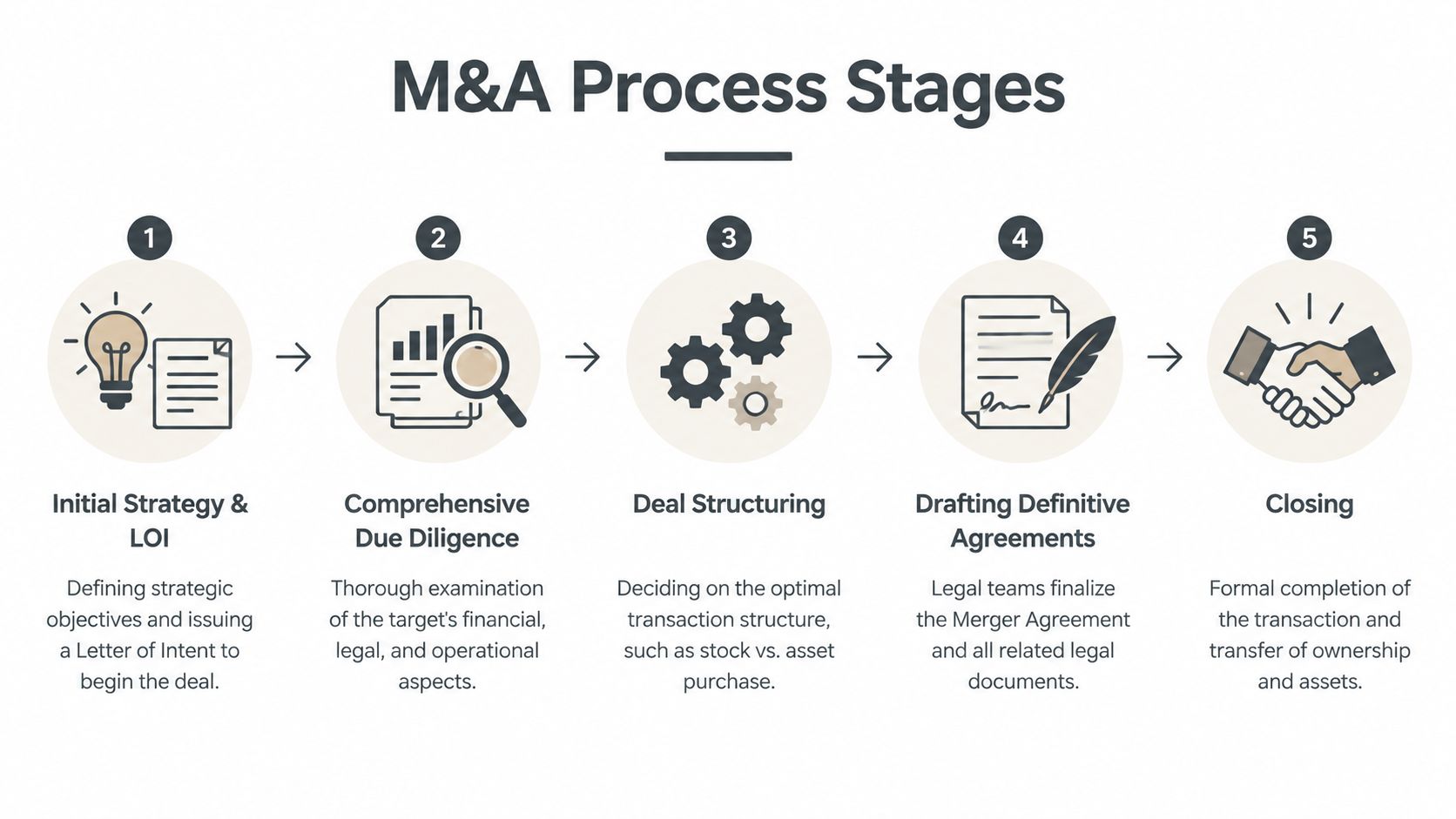
1. Initial strategy and the LOI
The buyer should define the commercial rationale before contacting the target. Is the acquisition intended to add customers, enter a geography, acquire intellectual property, reduce costs, or create a succession path? The answer determines which diligence findings matter most and whether an earnout, rollover equity, or continued employment is sensible.
The letter of intent should identify price mechanics, structure, exclusivity, confidentiality, access, expenses, expected timing, and conditions. Most business terms may remain nonbinding, but the binding provisions need precise language because they govern conduct while the parties decide whether to sign a definitive agreement.
2. Comprehensive due diligence
Diligence should test the assumptions behind the valuation. The team should review financial statements, tax filings, debt, working capital, material contracts, employment arrangements, benefits, intellectual property, litigation, insurance, data practices, regulatory history, environmental matters, and ownership of key assets.
A practical guide for financial due diligence can help organize the operational questions that sit beside the legal review. Counsel should turn findings into action. A weak customer contract may require a consent, a price adjustment, a special indemnity, or a closing condition.
3. Deal structuring
Structure should be chosen after the team understands the target's liabilities and the parties' tax objectives, not because one format is familiar. The buyer, seller, accountants, lender, and counsel should compare the legal and economic consequences of stock, asset, merger, and joint-venture alternatives.
4. Definitive agreements
The purchase agreement should establish the rules for signing, operating the business before closing, obtaining approvals, calculating consideration, and resolving post-closing claims. Key provisions include representations, warranties, covenants, conditions, termination rights, indemnification, escrow, earnout mechanics, restrictive covenants, and dispute resolution.
The disclosure schedules deserve the same attention as the agreement. An incomplete schedule can create a representation breach even when the underlying business issue was known informally.
5. Closing and integration
Closing requires more than signatures. The parties may need board and shareholder approvals, certificates, payoff letters, lien releases, regulatory clearances, third-party consents, officer resignations, employment documents, funds-flow instructions, and evidence that conditions have been satisfied.
Integration planning should begin during diligence. Buyers should assign owners for employee communication, systems migration, customer notices, branding, contracts, records, and compliance. A legally completed transaction can still lose value if the operating handoff is improvised.
The M&A due diligence checklist can serve as a starting point for assigning diligence requests and tracking unresolved issues.
Navigating the Regulatory Environment and Antitrust Compliance
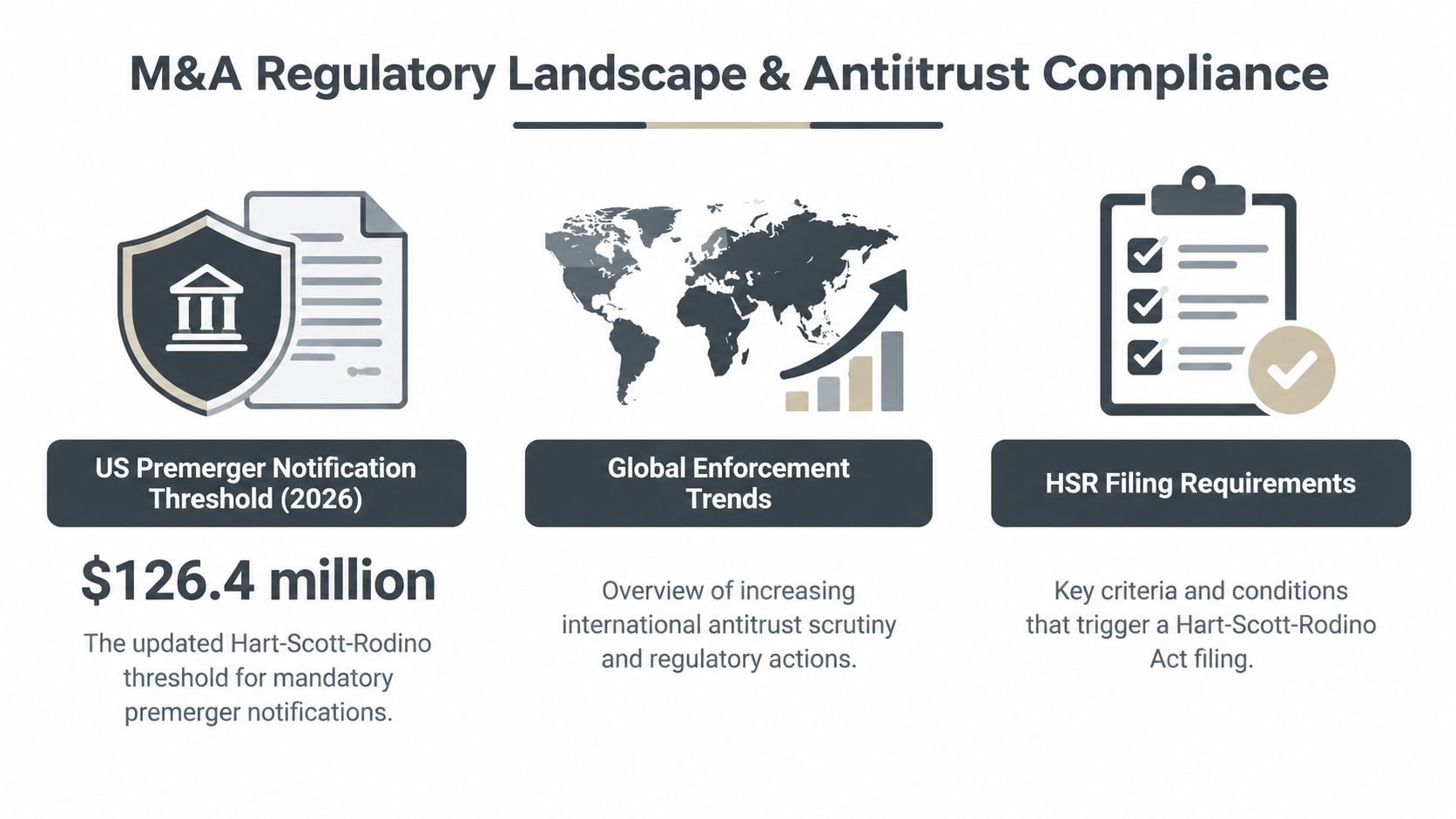
A transaction can meet its commercial targets and still stall after signing if the parties treat regulatory review as a closing formality. In 2026, the HSR Act requires filing when transaction value exceeds $133.9 million. Transactions above $535.5 million are reportable regardless of the size-of-person test, according to the FTC's 2026 threshold announcement. That test generally requires one party to have at least $267.8 million in sales or assets and the other to have at least $26.8 million, as summarized in this 2026 HSR threshold analysis.
Filing analysis is only the starting point. Counsel should examine overlaps involving products, customers, suppliers, labor, technology, and data. Clean-team protocols can limit access to competitively sensitive information, while controls on pre-closing conduct help prevent the parties from acting as though the deal has already closed. Those controls also protect governance processes by clarifying who may approve operational decisions during the interim period.
Remedies and closing risk
Antitrust outcomes can affect both drafting and deal economics. In 2025, prohibited or abandoned transactions dropped to 16 from 39 in 2024, while conditional clearances increased, according to A&O Shearman's 2026 global merger-control report. Fewer outright failures may reflect more negotiated remedies, additional information requests, and longer review periods rather than faster closings.
The purchase agreement should address:
- Regulatory efforts: Identify who controls communications, submissions, and remedy negotiations.
- Remedy limits: State whether the buyer must accept divestitures, licensing commitments, behavioral restrictions, or other business concessions.
- Timing protection: Set outside dates and extension rights that match the expected review process.
- Breakup economics: Align termination fees and reverse termination fees with regulatory and financing exposure.
For cross-border deals, build a jurisdiction-by-jurisdiction approval map. The EU Merger Regulation became a centralized framework on September 21, 1990, shifting major cross-border review toward a supranational system, as described in this history of EU merger control. The EU reviewed 384 notified mergers in 2025 and kept about 85% in the simplified procedure. A revised-guidelines consultation was underway, with a draft expected in spring 2026 and adoption anticipated in Q4 2027, according to the A&O Shearman report cited above.
Financial services add another approval layer. The Federal Reserve reported 145 approved M&A applications in 2025, up from 99 in 2024, representing 16.4% of total approved applications, according to its 2026 supervision and regulation report. Australia adopted a mandatory and suspensory merger-control regime effective January 1, 2026. Ireland raised mandatory filing thresholds on July 1, 2026 and retained call-in authority for below-threshold deals. Regulated buyers should make industry approvals, antitrust clearance, tax assumptions, and interim governance responsibilities part of the same closing analysis.
Use this regulatory compliance guidance to assign approval owners, document filing requirements, and address unresolved regulatory issues before signing.
Tax Implications and Governance Mechanics
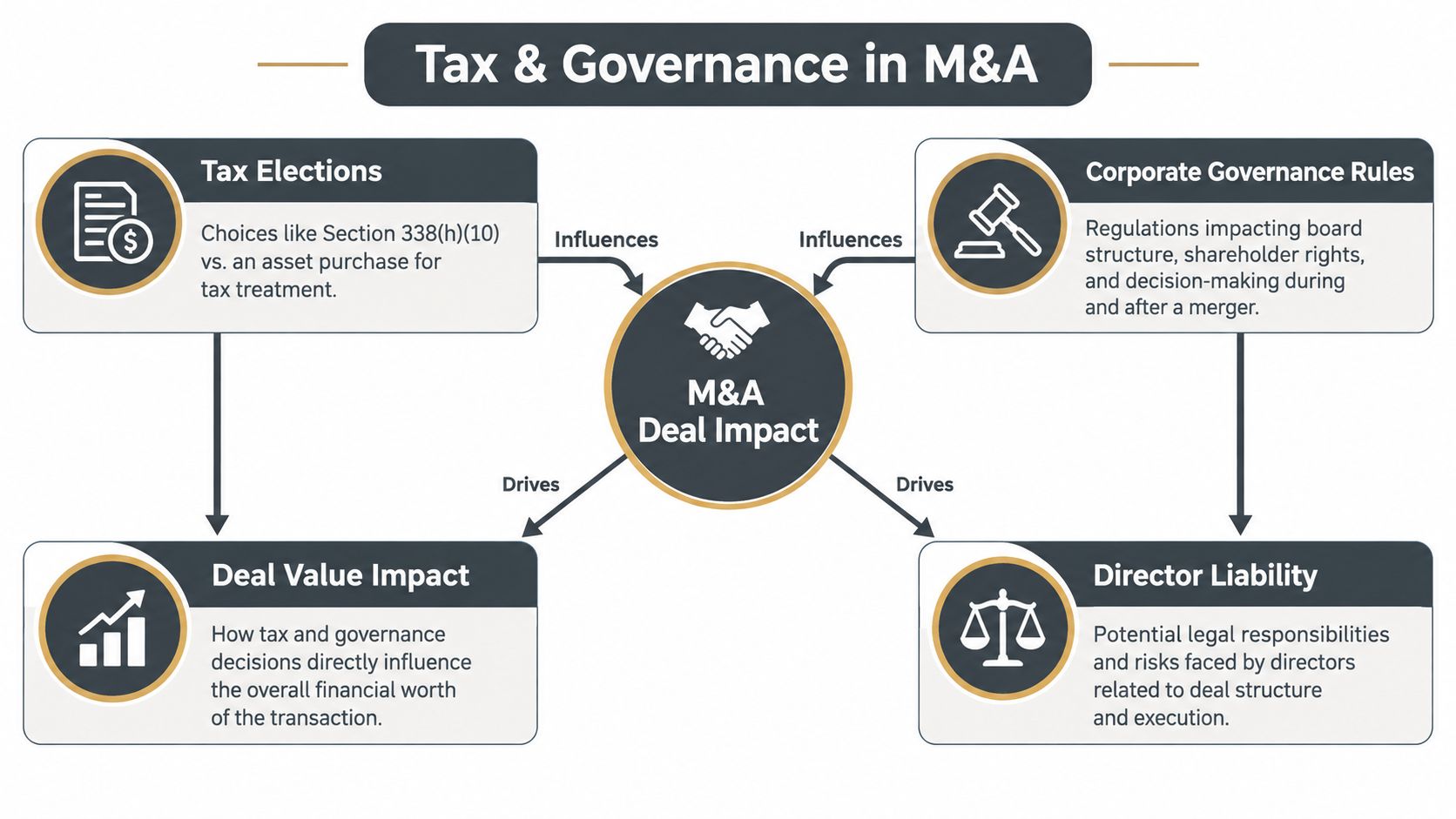
Tax planning and corporate governance should be evaluated together because the most tax-efficient structure may require approvals, disclosures, or board processes that affect execution risk. A stock transaction, an asset purchase, and an election such as Section 338(h)(10) can produce different results for the buyer, seller, shareholders, and operating company. The parties should model those consequences before the purchase agreement fixes the structure.
An asset purchase may give the buyer a basis profile it values, while the seller may prefer stock treatment or a structure that limits transaction-level friction. A Section 338(h)(10) election can treat a stock acquisition in a manner that resembles an asset sale for tax purposes, but its availability, allocation mechanics, and economic consequences require tax advice specific to the entities and owners involved.
Board process and review standards
The board must understand the transaction it approves, the alternatives considered, the financial analysis, and the conflicts that may affect decision-making. Under Delaware law, an informed and uncoerced approval by a majority of disinterested stockholders generally receives business judgment review. Conflict-heavy transactions can instead receive entire fairness review, which examines both fair dealing and fair price under Delaware's most demanding standard, as explained in this analysis of Delaware standards of review.
The practical response is procedural discipline:
- Identify conflicts early: Determine whether directors, officers, controlling holders, or advisers have interests different from the broader shareholder base.
- Use an independent committee where appropriate: Give the committee a real mandate, independent advisers, sufficient information, and time to negotiate.
- Document the record: Preserve presentations, meeting minutes, valuation materials, alternatives, and the board's reasons.
- Coordinate tax and governance advice: A tax election should not appear as an unexplained late change to the board or shareholders.
Board discipline matters: A favorable price doesn't cure a process that appears rushed, conflicted, or uninformed.
Governance provisions also matter after closing. Rollover equity, earnouts, board appointment rights, veto rights, and integration authority can create disputes if the agreement doesn't define operational control. The transaction team should ask who decides, what information each party receives, and how disagreements end. That work protects value more effectively than relying on broad promises to cooperate.
Identifying Common Risks and Resolving Disputes
A buyer closes an asset acquisition and later discovers that a seller's sales representative promised customers renewal terms that weren't reflected in the disclosure schedules. The buyer claims a breach of the representations and seeks recovery from escrow. The seller argues that the buyer knew about the sales practice during diligence and that the alleged loss reflects integration decisions rather than a pre-closing breach.
That dispute turns on details counsel can address before signing: the definition of knowledge, disclosure standards, materiality qualifiers, survival periods, claim notices, causation, mitigation, exclusive-remedy language, and the relationship between indemnification and insurance. A broad representation with a narrow disclosure schedule may create one result. A carefully crafted special indemnity may create another.

Three recurring post-closing pressure points
Representations and warranties: Buyers often want broad coverage, while sellers seek finality. The negotiated cap, basket, survival period, exclusions, and fraud carveout should reflect the diligence record and the parties' relative bargaining power.
Earnouts: An earnout can bridge a valuation gap, but it can also invite conflict if the buyer controls staffing, pricing, accounting, or investment after closing. Define the metric, accounting rules, information rights, operating covenants, dispute expert, and payment timing with precision.
Integration and control: Former owners may expect influence that the definitive agreement never granted. Buyers may change systems or personnel quickly, then face claims that they intentionally prevented performance. Governance rights and post-closing operating authority should be explicit.
Mediation can preserve relationships when the parties have an ongoing commercial connection. Arbitration may offer a private process and a specialized decision-maker, but it still requires clear rules on discovery, emergency relief, fees, and consolidation. Court litigation remains important where a party needs broad discovery, injunctive relief, or enforcement against third parties.
Before approving an earnout or rollover arrangement, decision-makers should distinguish projected value from guaranteed value. This discussion of understanding expected investment returns provides useful context for explaining why forecasts and contractual entitlements aren't the same thing.
Partnering with Counsel for Successful M&A
M&A counsel should enter the process before the parties have locked themselves into a structure. Early advice can identify approval requirements, contract-transfer problems, conflicts, tax-sensitive alternatives, financing conditions, and liability concerns while the parties still have room to adjust the deal.
Effective counsel coordinates several workstreams:
- Transaction design: Compare stock, asset, merger, and joint-venture structures against commercial and tax objectives.
- Diligence management: Organize requests, evaluate findings, and convert risks into price changes, covenants, conditions, or indemnities.
- Agreement negotiation: Draft provisions that address representations, remedies, earnouts, escrow, termination, and regulatory risk.
- Governance support: Prepare board materials, committee processes, approvals, and records that reflect informed decision-making.
- Closing and integration: Track deliverables, consents, funds flow, ownership transfer, and post-closing obligations.
Kons Law's corporate and commercial practice handles mergers and acquisitions, asset purchases, business sales, contract negotiation, governance, and regulatory compliance. Its commercial litigation practice can also address contract and post-closing disputes through negotiation, arbitration, or trial when a transaction doesn't proceed as expected.
If you want to discuss your business law matter, contact Kons Law at (860) 920-5181. The firm can help evaluate transaction structure, diligence findings, antitrust and tax considerations, governance processes, and closing documents, then guide the deal toward a clear and workable outcome. Visit Kons Law to begin a conversation about your next acquisition, merger, or business sale.
