You see a headline announcing a Fed rate cut while reviewing your business credit line, retirement account, or next mortgage payment. Cheaper borrowing sounds welcome, but the announcement also raises an uncomfortable question: does the central bank know something worrying about the economy?
Why does the Fed lower interest rates? Usually, it's trying to support spending, investment, and employment when economic conditions are weakening or inflation is too low. The distinction matters: a cut can make money cheaper while also signaling that businesses and households are under pressure.
The Core Reasons the Fed Lowers Interest Rates
A rate-cut headline announces an attempt to influence economic activity, not a promise that your lender will immediately reduce your payment. Think of the federal funds rate, the overnight rate banks charge one another, as a dial policymakers adjust to encourage or restrain demand.
The Federal Open Market Committee, or FOMC, sets the target range through announced policy decisions, including at its scheduled meetings. A cut isn't a surprise instruction from a single official to every bank.

Employment and prices guide the decision
The Federal Reserve's explanation of its monetary-policy goals identifies its statutory mandate as maximum employment and stable prices, with a longer-run inflation objective of 2%, measured by the annual change in the personal consumption expenditures price index. Those goals explain why policymakers sometimes want borrowing to become easier.
When customers spend less than businesses can sustainably produce, employers have less reason to add equipment, expand premises, or hire. Households may postpone buying homes, automobiles, and other durable goods because they're worried about income or financing costs. Weaker demand can therefore increase unemployment while reducing inflation.
Persistently low inflation isn't automatically a sign of economic health. It can indicate insufficient spending and increase the risk of deflation, a broad decline in prices. If people expect purchases to become cheaper, they may delay spending, while existing debts become harder to repay relative to falling prices and income.
Economic conditions that trigger a Fed rate cut
| Economic condition | Fed response | Reason |
|---|---|---|
| Weak hiring and rising unemployment | Lower the federal funds rate | Cheaper credit encourages firms to hire and invest |
| Inflation persistently below the longer-run objective | Lower the federal funds rate | Weak inflation can signal insufficient demand and raise deflation risk |
| Demand falling behind productive capacity | Lower the federal funds rate | Encourages spending that supports sustainable output and employment |
| Severe recession with financial stress | Cut aggressively, potentially toward near zero | Helps interrupt a cycle of layoffs and falling spending |
These are policy responses, not automatic rules. Policymakers must weigh the combined employment and inflation outlook rather than react mechanically to an isolated weak report.
For readers sorting out related terminology, Finzer's glossary provides context for quantitative easing and inflation terms. Understanding those distinctions helps avoid treating every form of monetary easing as the same action.
A rate cut is a response to economic conditions. Its success depends on whether households and businesses can, and want to, act on the cheaper financing.
How a Rate Cut Reaches Your Loans and Investments
Think of the federal funds rate as the first domino in a line. Changing it can influence other rates and financial decisions, but the remaining dominoes don't all fall together.
Say a manufacturer is considering replacing an aging machine. The purchase makes sense only if the expected additional earnings justify the financing cost and business risk.
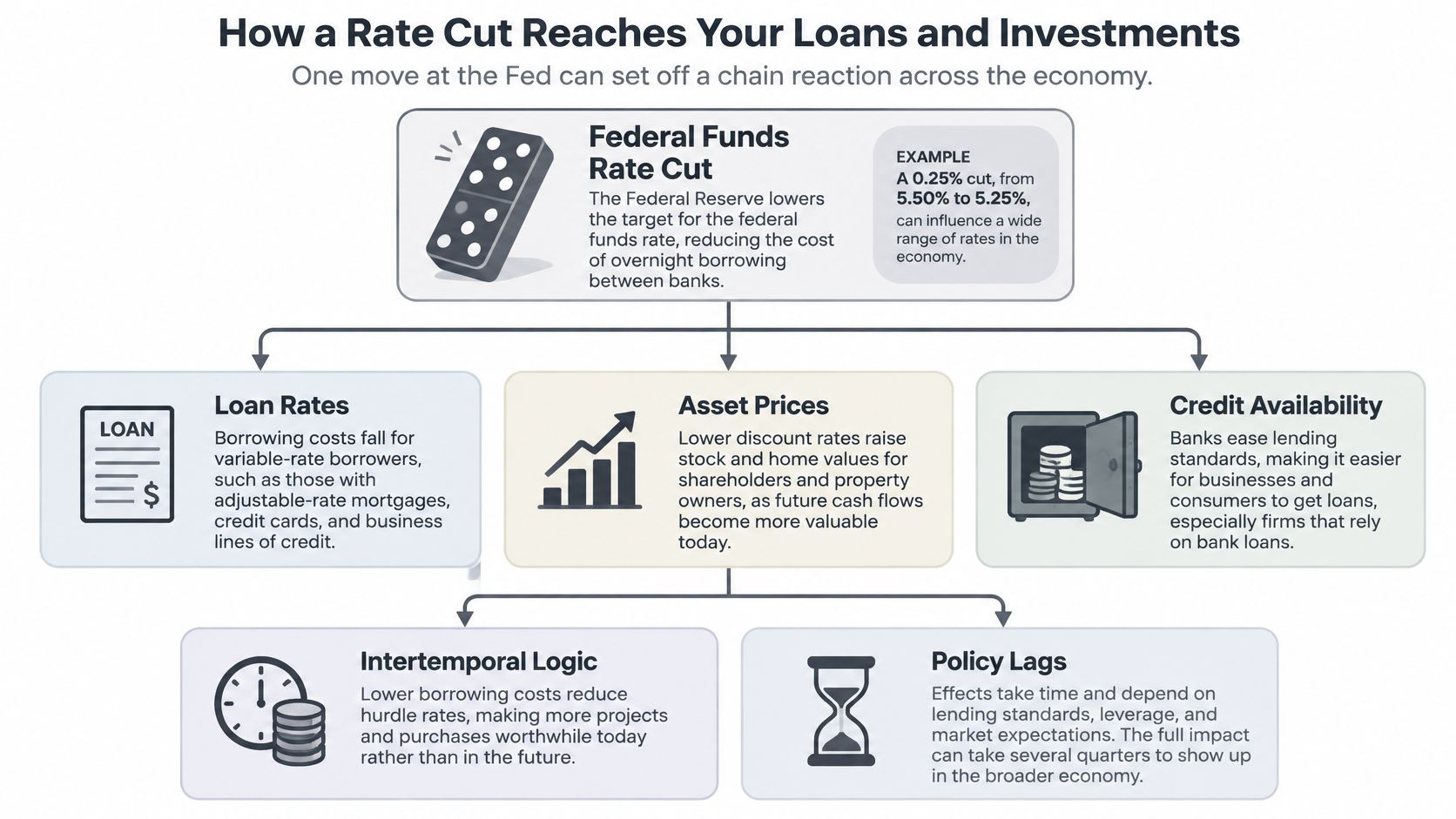
From the overnight benchmark to a business decision
The Federal Reserve's guide to how monetary policy works explains how policy changes influence borrowing costs, financial conditions, spending, and investment. Short-term market rates respond through expectations and arbitrage, meaning investors adjust transactions when comparable financing opportunities offer different returns.
If the manufacturer receives a cheaper loan offer, the machine has a lower hurdle rate, the return needed to justify buying it. The owner may proceed with a purchase that previously looked too expensive. Households face a similar choice when weighing a financed purchase against waiting.
Other effects involve asset values. Investors use discount rates to translate future earnings or income into present value. Lower discount rates can support higher valuations, potentially increasing household and business net worth and encouraging spending.
Transmission channels of a Fed rate cut
| Channel | What changes | Who feels it first | Typical lag |
|---|---|---|---|
| Loan rates | Business and consumer borrowing costs can fall | Variable-rate borrowers and those refinancing | At contractual resets or when new financing is obtained |
| Asset prices | Lower discount rates can raise stock and home valuations | Shareholders and property owners | Markets may respond before the announcement if they anticipate it |
| Credit availability | Banks may ease lending standards as conditions improve | Firms that rely on bank loans | Through underwriting reviews and lending decisions, constrained by leverage and credit risk |
A bank isn't required to approve the manufacturer's application because the Fed has eased policy. If the company is heavily indebted or its orders are falling, the lender may demand a larger risk premium or decline the loan.
Practical rule: Track the financing offer you can actually obtain, not just the benchmark in the headline.
For a business, the relevant measure is the all-in cost of capital, including the benchmark, lender margin, fees, and other financing requirements. Understanding what a promissory note is can help you identify which obligations are contractual rather than controlled by monetary policy.
For revolving consumer debt, Toya AI's guide to how to lower your card's rate offers a separate borrower-level perspective. A central-bank announcement and a lender's decision about your account aren't interchangeable.
Track actual loan quotes, account notices, portfolio valuations, and credit approvals. Those tell you whether the policy change has reached your finances.
Why the Same Cut Helps Some Borrowers More Than Others
A Fed cut isn't good news for everyone. Borrowers may gain payment relief, savers may receive less income, and asset owners may benefit without changing their borrowing at all.
The Bank for International Settlements paper on differences across households and firms describes cash-flow, wealth, income, and credit channels. Financially connected households tend to respond more directly, while financially excluded households experience monetary-policy effects more indirectly.

Similar businesses can receive different relief
Consider a hypothetical café owner whose credit line reprices at the next monthly reset. If the contract's reference rate falls and no interest-rate floor prevents an adjustment, the interest charge can decline at that reset.
Another café owner has a fixed-rate term loan. The existing payment doesn't change just because the Fed cuts rates. That owner would need to examine refinancing or renegotiation, including fees and eligibility, before expecting savings.
The first owner could redirect payment savings toward inventory or payroll. The second might see no immediate debt-service relief, even though both read the same headline. Neither should assume customers will begin spending more right away.
Check the terms that control the outcome
The speed and size of any benefit turn on specific details:
- Repricing terms and index resets: Identify the reference rate, adjustment schedule, and any floor.
- Refinancing dates: Determine when replacement financing is available and whether an early payoff creates costs.
- Underwriting standards: Ask whether the lender has changed collateral, documentation, or approval requirements.
- Credit quality: Review the borrower's repayment record, debt levels, and current financial condition.
- Customer exposure: Consider whether the economic weakness prompting the cut could reduce revenue.
Savers face the other side of cheaper funding. Lower deposit income may leave someone with less money to spend, while higher asset valuations tend to benefit people who already own substantial financial or property assets.
A lower policy rate doesn't override a loan contract, improve a borrower's credit record, or guarantee more customers.
For an owner managing cash flow for a small business, the useful exercise is to forecast actual receipts and payments. Check contractual repricing dates before counting a rate cut as available cash.
What a Cut Signals About the Economy
During the financial crisis and Great Recession, the Fed reduced its target federal funds rate by approximately 5.5 percentage points, brought the target range close to zero by the end of 2008, and maintained near-zero policy for about seven years, as described in the Federal Reserve's monetary-policy overview. That episode illustrates how forcefully policymakers may respond when private demand collapses.
The underlying problem can become self-reinforcing. Businesses with falling sales lay off employees, households lose income, customers spend less, and employers face another decline in demand.

Crisis response versus preventive easing
Rate cuts aim to interrupt that cycle by making spending and investment more attractive. But they can't instantly repair damaged balance sheets, restore lenders' confidence, or eliminate credit-market stress. A household already struggling with debt may remain unwilling or unable to borrow.
A different rationale appears in Governor Christopher Waller's November 2025 speech: he described underlying inflation as relatively close to the FOMC's 2% target, characterized the labor market as near “stall speed,” cited average private-sector job creation of 27,000 per month from May through August versus 143,000 per month during the preceding six months, and supported another 25-basis-point cut as risk management. That was an argument for preventive action, not evidence that every economic problem had been resolved.
A deep crisis cut compared with a late 2025 insurance cut
| Feature | Financial-crisis cuts | Late-year insurance-cut argument |
|---|---|---|
| Trigger | Financial crisis and Great Recession | Labor market near stall speed |
| Size of cuts | Large cumulative reduction | Smaller additional reduction advocated by Waller |
| Inflation backdrop | Risk of inflation falling dangerously below the desired level | Underlying inflation relatively close to the objective |
| Outcome | Prolonged near-zero policy | A recommendation intended to limit employment deterioration, not a demonstrated outcome |
The distinction in the final row matters. A policymaker's recommendation establishes a rationale, not proof that the proposed action occurred or achieved its intended result.
Why cut rates if prices are still rising?
Rising prices and rising inflation aren't the same thing. Prices can continue increasing even while the pace of increase slows. The Fed doesn't need broad price declines before it considers whether existing policy is putting too much pressure on employment.
Policymakers also act with an eye on future conditions because monetary policy works with lags. Waiting until unemployment has deteriorated severely could mean responding after employers have already canceled expansion plans and reduced payrolls.
That creates a genuine trade-off. Keeping rates restrictive may weaken employment further; easing too soon may encourage enough spending to reignite inflation. Policymakers must weigh those risks rather than treat either objective as already secured.
Separate the message from the mechanism: Cheaper financing can help a business even when the reason for that financing relief is troubling.
For investors, that distinction also affects positions funded with borrowed money. Understanding what a margin call is remains important because easier monetary policy doesn't eliminate collateral requirements or the possibility of falling security prices.
Read a cut through separate lenses: the liquidity effect, which concerns financing and cash availability, and the signal effect, which concerns the economic weakness policymakers are trying to address. Either can matter more to your business or portfolio than the other.
What Rate Cuts Mean for Investors and Advisors
Start with the holding, not the headline. An investor who relies on deposit income faces a different decision from a business owner carrying floating-rate debt or an advisor reviewing a client's bond portfolio.
The practical question is whether a change affects income, market value, repayment obligations, or access to cash. Those effects can point in different directions within the same household.
How a rate cut affects common holdings
| Holding | Typical effect of a cut | What to check |
|---|---|---|
| Variable-rate loans | Interest payments fall as the relevant benchmark resets, subject to contract terms | Index, margin, floors, and reset dates |
| Fixed-rate mortgages | Little immediate change | Refinancing timing, fees, and penalties |
| Savings and deposit accounts | Yields tend to fall | Rate paid versus new market rates |
| Equity holdings | Higher present value of earnings can lift valuations | Whether the cut reflects weakening earnings |
| Bond portfolios | Existing bond prices typically rise when yields fall | Duration and reinvestment risk |
For a variable-rate loan, read the adjustment provision before estimating a lower payment. Confirm that the relevant benchmark changed and that the lender's margin remains the same.
For a fixed-rate mortgage, request a complete refinancing estimate rather than comparing advertised interest rates alone. Closing costs, expected ownership period, and any prepayment penalty can determine whether refinancing offers meaningful relief.
Review income needs alongside market values
With savings and deposits, compare the rate on your statement against available alternatives, while preserving the liquidity you need. An account that looks convenient may no longer produce the income assumed in your spending plan.
With equities, distinguish a valuation benefit from an earnings forecast. Lower discount rates may support the price investors will pay, but weaker customer demand can reduce the earnings they're buying.
With bonds, separate market-price changes from future income. Existing fixed-rate bonds generally become more valuable when comparable yields decline, but reinvesting coupons or maturing principal may produce less income. Duration helps assess price sensitivity; credit quality still requires its own review.
Advisor checkpoint: A portfolio can show a higher market value while providing less income for the client's next spending need.
Don't infer liquidity from a security's interest-rate label. For less familiar instruments, understanding auction-rate securities is part of examining how the rate is established and how an investor can exit.
Advisors should document which client assumptions have changed before recommending transactions. Review cash needs, contractual payment changes, maturity schedules, and liquidity constraints, then explain the expected timing without promising an immediate benefit.
Confirm the Reason Before You Act on a Cut
Treat a Fed cut as a reason to review your position, not an instruction to refinance, borrow, or trade. A useful decision process connects the economic rationale to your actual obligations.
Name the condition. Read the policy explanation and identify the main concern: weakening employment, insufficient inflation, or financial stress. Don't substitute a headline's upbeat or alarming tone for that explanation.
Map your repricing dates. Create a debt-and-deposit worksheet with each account's benchmark, reset date, and refinancing or exit costs. Use contracts and account disclosures rather than assumptions about what should happen.
Separate relief from warning. Put confirmed payment savings into your cash-flow forecast, then test a separate scenario with weaker customer or client activity. Don't spend expected savings before the lender confirms them.
Re-test your holdings. Review your actual positions for income changes, valuation sensitivity, and liquidity needs. Record what justifies a change and what supports leaving the holding alone.
A cut is both a price change and an economic signal. Acting on only the cheaper-money story can leave you unprepared for weaker revenue, while focusing only on recession risk can cause you to overlook genuine financing relief. Make the decision from your contracts, cash requirements, and exposure to changing business conditions.
Kons Law advises businesses on financing agreements, commercial contracts, and disputes, and represents investors and financial professionals in securities matters. Visit Kons Law to learn about counsel for the legal obligations behind your borrowing and investment decisions. If you want to discuss your business law matter, contact Kons Law at (860) 920-5181.
