A FINRA notice often arrives in the middle of an ordinary workday: an advisor receives a request for records, or a compliance officer learns that staff want information about a customer complaint or trading activity. The immediate question is whether the notice means someone has already decided wrongdoing occurred. It doesn't. But the response can create a separate problem if it's late, incomplete, inaccurate, or handled without a plan.
The FINRA investigation process is a branching workflow, not one event. A matter may start with a filing, complaint, examination, or data alert, then move through document production, testimony, evidence review, and either closure, settlement, or a contested proceeding. Each stage presents a decision point. The practical challenge is to address the facts under review while avoiding a response mistake that turns an inquiry into an independent disciplinary case.
What a FINRA Investigation Actually Looks Like
An advisor who receives a sudden FINRA request may first wonder whether the firm is being examined, whether the advisor is a witness, or whether staff are focused on the advisor's own conduct. The notice and the surrounding circumstances matter, but receiving a request alone doesn't establish that FINRA has found a violation. What matters immediately is understanding what the request covers, who controls the responsive records, and when a response is due.

A matter can also begin without public notice. A firm's Form U5, filed when an associated person leaves, may prompt FINRA to examine the circumstances described in the filing. FINRA decisions describe cases that began after a Form U5 was received, followed by written requests to the former representative and the broker-dealer. The filing doesn't prove the allegations, but it can place the underlying events under regulatory review.
The process is easiest to understand in four phases: trigger, response, review, and resolution. First, FINRA learns of an issue through a complaint, filing, examination, referral, or surveillance. Next, staff collect records and may request written answers or sworn testimony. Staff then assess the evidence and applicable rules before deciding whether to recommend formal discipline. The matter may close, resolve through settlement, or proceed to a hearing.
Practical rule: Treat the first request as the start of an evidentiary record. Preserve relevant materials and work out a complete, accurate response before the record starts to harden around gaps or inconsistencies.
CRD records, Form U5 language, firm documents, and an individual's later statements can all become relevant to the same sequence of events. A response strategy should account for that connected record from the outset, rather than treating each request as an isolated administrative task.
How a FINRA Case Starts and the Triggers You Should Know
A request for trading records arrives during a routine examination. Before treating it as an administrative task, identify what staff are testing: a trading pattern, a customer's allegations, or a weakness in supervision. That distinction shapes which records and explanations deserve attention first. FINRA identifies surveillance, examinations, regulatory filings, complaints, tips, referrals, and press reports as possible origins of an investigation.
The entry point sets the initial scope. Related evidence can widen it.
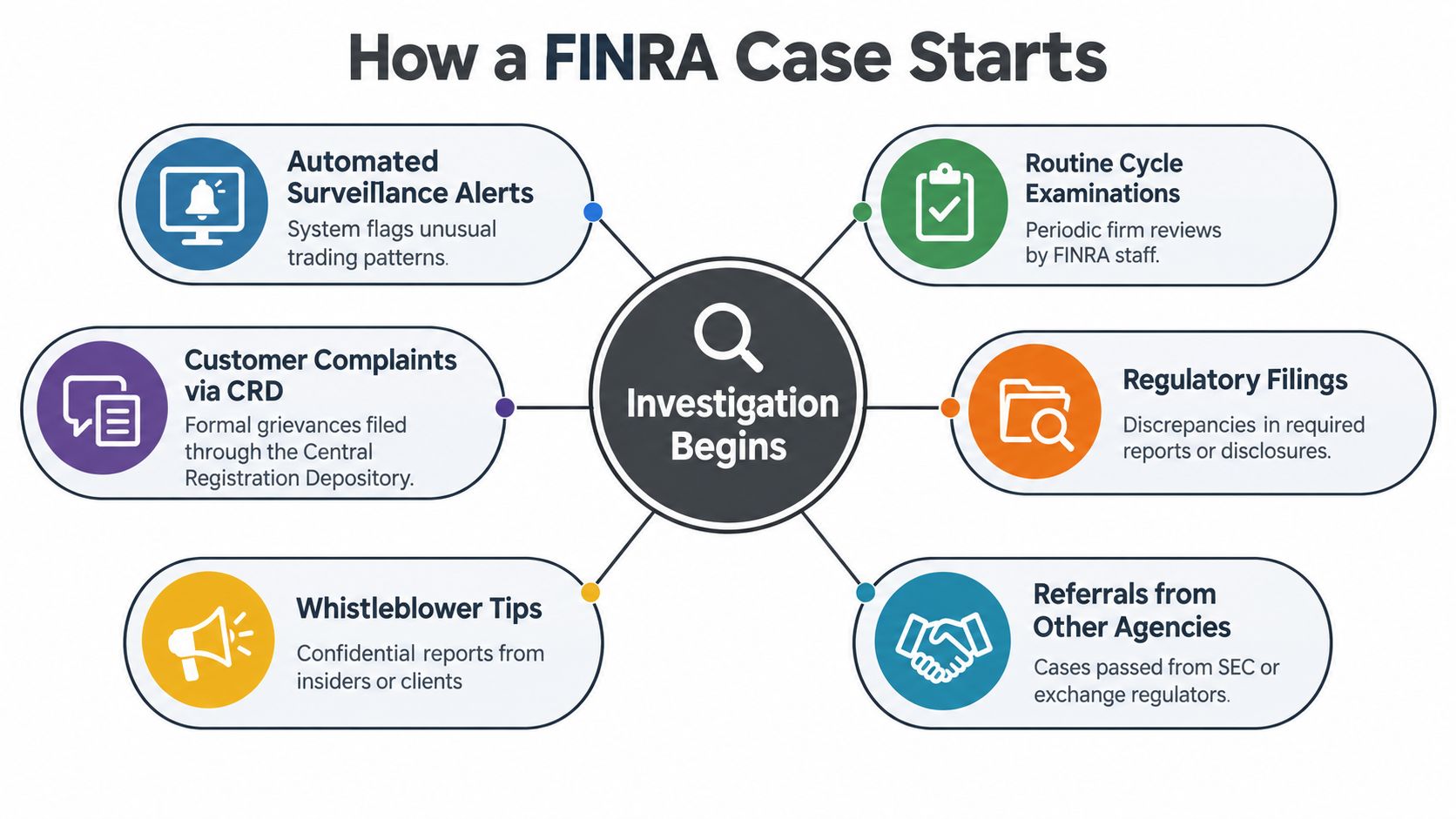
Each route presents a different starting question:
- Automated surveillance: Systems flag trading patterns for staff review. A flag remains a lead at this stage, though it can prompt requests for transaction records and explanations. Identify the activity behind the alert before offering an explanation.
- Routine examinations: A review of firm operations can expose records or practices requiring closer examination. The practical question is whether the issue concerns an isolated event or a recurring practice.
- Customer complaints: A grievance recorded through FINRA's systems can focus attention on account activity, communications, and supervision. Compare the allegation with the account record before adopting either the customer's or representative's characterization.
- Regulatory filings: A disclosure or report may prompt questions about how an event occurred and whether records are complete. Differences between the filing and underlying documents need a supportable explanation.
- Tips and referrals: Clients, insiders, other regulators, or FINRA departments can identify conduct outside a routine review. Assess the specific allegation even when the source's perspective appears incomplete.
- Press reports: Public reporting can prompt records requests concerning a member or associated person. Keep the response tied to documented conduct rather than the report's framing.
Data collection methods also affect the early workload. According to FINRA's account of its changing data-request approach, approximately 85% to 90% of examinations historically began with a large trading-blotter request, its newer approach reduced the initial request by 50%, total requests declined 12% in one year, and blue-sheet requests fell from approximately 273,000 in 2022 to 80,000 in 2025, a reported 70% decline. Blue sheets help identify and reconstruct securities transactions. Smaller initial requests still require accurate production; their size alone says little about the concern under review.
Formal enforcement totals offer limited guidance for an individual matter. The useful decision point is whether the available records answer staff's concern or expose additional conduct requiring review. A quick explanation may save time, yet an unsupported one can create inconsistencies that broaden the inquiry.
Rule 8210 Explained as a Compulsory Regulatory Demand
A Rule 8210 request isn't an informal invitation. Within the scope of an authorized investigation, examination, complaint, or proceeding, FINRA can require member firms, associated persons, and others subject to its jurisdiction to provide information, produce documents, answer questions orally, in writing, or electronically, and testify under oath. FINRA can also inspect and copy books, records, and accounts.
The request's format doesn't change the duty to take it seriously. A written response may need to address specific events; an electronic request may call for records in a defined format; testimony creates a sworn account that can be compared with documents and other witnesses' statements. The authority has limits, but its practical reach can include core business records. In an SEC decision involving Primex, a Rule 8210 request during a routine examination sought the firm's annual audit and general ledger. (The Primex decision)
The key enforcement risk is that the response itself can become the alleged violation. FINRA reported that, during the two years preceding July 2020, it barred more than 730 brokers and associated persons; more than one-third of the enforcement cases resulting in those individual bars involved alleged Rule 8210 violations. (FINRA's discussion of Rule 8210 and cooperation)
That history is why a respondent shouldn't use silence, selective production, or an unsupported answer to gain advantage. FINRA's published decisions state that a complete failure to respond ordinarily warrants a bar from associating with a member, though mitigating circumstances may support a suspension of up to two years. An incomplete or inaccurate response that isn't promptly corrected can also create independent disciplinary exposure.
An 8210 request is part of the evidence, not just a checklist of items to send.
For an explanation of the rule's practical implications, see Kons Law's discussion of FINRA Rule 8210. Before responding, identify each request, locate likely custodians, preserve responsive records, and document any issue that affects completeness, timing, or the ability to produce a particular item.
The Internal Workflow From Inquiry to Sufficiency Review
Once staff open a matter, the working file develops through evidence collection and assessment. The details vary, but the basic sequence helps explain why early responses carry weight.
Intake and triage. Staff assess the information that brought the matter to FINRA and determine what questions need examination. An inquiry may remain narrow, or the initial lead may point to wider issues involving the firm, an associated person, or particular transactions.
Document and data collection. Staff may issue Rule 8210 requests for records and explanations. Later requests can follow when initial materials raise new questions or leave gaps. A consistent record matters: unexplained differences between a response and the underlying documents can shift attention from the conduct being investigated to the accuracy of the response.
Sworn testimony. FINRA may require testimony from the individual under review or from relevant witnesses. A prepared witness should understand the records and timeline, answer the question asked, and correct an answer if they later learn it was inaccurate. Guessing, overstating certainty, or trying to fill a gap with recollection can create avoidable problems.
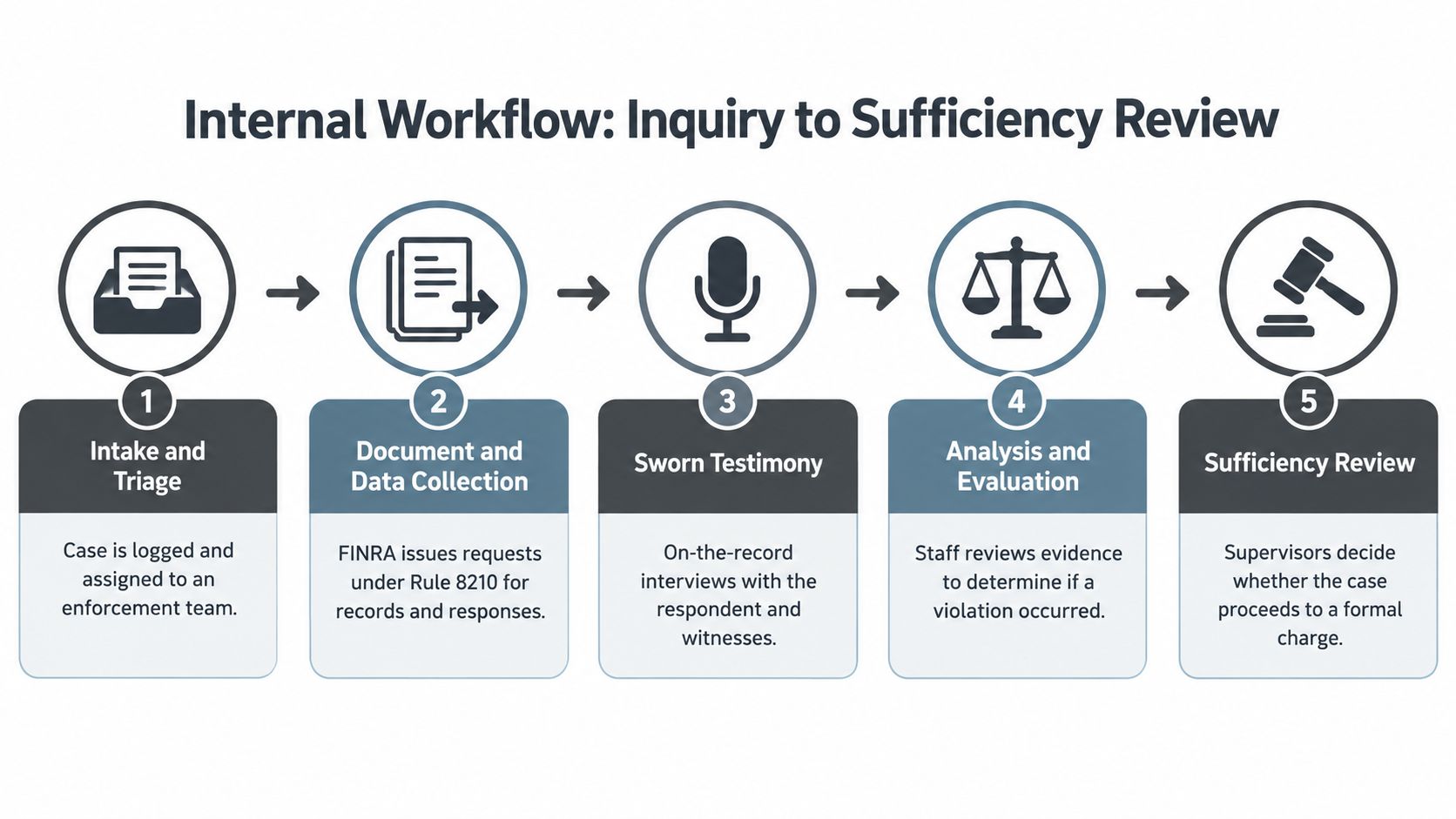
After gathering documents and sworn testimony, FINRA staff analyze the evidence and applicable law under the supervision of the responsible senior manager. That manager decides whether the apparent conduct warrants a recommendation for formal disciplinary action. This review, known as a Sufficiency of Evidence review, makes evidentiary gaps important before charges are proposed. (FINRA's description of its investigation and review process)
If staff make a preliminary decision to recommend formal discipline, they generally notify the potential respondent or counsel before proceeding. That creates a practical opportunity to address chronology, intent, supervision, and corrective action with evidence rather than broad denials. FINRA describes investigations as non-public and states that firms and individuals may be represented by counsel. Early legal involvement can help ensure the record explains not only what happened, but also what the documents support and what remains uncertain.
Choosing Between Settlement and a Contested Hearing
When FINRA is considering formal discipline, the respondent may face a choice between a negotiated resolution and contesting the allegations. The right path depends on the evidence, the proposed findings and sanctions, the client's goals, and the consequences of a public disciplinary record. Neither option is automatically safer.
An Acceptance, Waiver and Consent (AWC) can resolve a matter without a contested hearing. In exchange for accepting the stated findings and sanctions and waiving the hearing process, the respondent may avoid the expense and uncertainty of litigation. The trade-off is that the agreement creates a formal disciplinary outcome, and its terms can affect professional reputation, future employment, and how the matter is understood by firms and customers.
A contested case proceeds through FINRA's Office of Hearing Officers (OHO). If FINRA files a formal Complaint, the respondent normally has 25 calendar days after service to file an Answer. The deadline is 28 days when service is made by first-class, certified, or registered mail. An initial pre-hearing conference is generally scheduled within 21 days after the Answer is served, subject to the Hearing Officer's authority to find a conference unnecessary or premature. (FINRA's guide to the disciplinary hearing process)
A FINRA disciplinary hearing is conducted before a three-person panel chaired by an OHO hearing officer. After the hearing, post-hearing submissions generally are due within 60 days, unless the Hearing Officer orders otherwise, and are limited to 25 pages excluding specified front matter. OHO decisions commonly issue approximately four to six months after the hearing concludes. The process allows the respondent to contest the evidence, but it also requires a sustained litigation effort and leaves the outcome to the adjudicatory process. (FINRA's overview of OHO hearings)
| Consideration | AWC | Contested hearing |
|---|---|---|
| Process | Negotiated resolution with agreed findings and sanctions | Formal Complaint, Answer, evidence, and hearing |
| Main trade-off | Greater procedural speed, but formal findings are accepted | Opportunity to dispute the case, with added process and uncertainty |
| Strategic question | Do the terms fairly reflect the evidence and mitigation? | Can the evidence and law support a meaningful challenge? |
The respondent's broader goals matter. A resolution that limits uncertainty may still carry consequences for employment or parallel disputes. A contested hearing may preserve the ability to challenge the allegations, but only if the record and legal arguments justify that course. For further procedural context, review Kons Law's guide to the FINRA Code of Procedure.
Your Rights and Obligations When You Receive Notice
A FINRA inquiry doesn't itself establish that a violation occurred. At the same time, a recipient subject to FINRA's jurisdiction must respond to a valid Rule 8210 request. The useful distinction is between challenging or clarifying a request through counsel and failing to answer it.
Start by preserving potentially responsive records. That can include business emails, text messages, account documents, calendars, notes, and firm-held materials. Don't delete, edit, or recreate records to make them look complete. Then map each request to the relevant custodian and record source so the response can be checked against the underlying documents.
If the request is broad, unclear, or difficult to meet by the stated deadline, raise the issue promptly. Counsel can ask FINRA to clarify scope, seek additional time, explain that certain materials are unavailable, and preserve legitimate objections concerning relevance or privilege. The point is to communicate and document the issue, not to treat an objection as permission to disregard the request.
A reliable response practice: Make every answer traceable to a record or a clearly identified source of personal knowledge. If an earlier answer turns out to be incomplete or inaccurate, correct it promptly rather than hoping the discrepancy goes unnoticed.
Testimony needs the same discipline. Review the relevant documents and chronology beforehand, distinguish what you know from what you infer, and ask for clarification when a question is unclear. Don't speculate to appear cooperative, and don't use a broad denial when the record calls for a precise answer.
FINRA states that an 8210 inquiry alone doesn't show that a violation occurred, but failure to respond, or an incomplete or inaccurate response that isn't promptly corrected, can independently support expedited proceedings or discipline, including fines, suspension, or a bar. (FINRA's Rule 8210 information and testimony FAQs) A disciplined response preserves objections while meeting applicable obligations. Silence and selective answers can turn a question about underlying conduct into a separate case about cooperation.
Where a FINRA Case Connects to Form U5, Arbitration, and Other Forums
A FINRA inquiry can overlap with disputes outside the investigation itself. The same events may appear in a Form U5, a customer arbitration, an employment disagreement, or a separate regulatory review. Those matters don't necessarily follow the same process, but statements and records in one forum can affect how the others are understood.
A Form U5 is especially important when the inquiry follows a departure from a firm. FINRA decisions describe investigations that began after a firm filed a Form U5 and continued through written Rule 8210 requests to the former representative and broker-dealer. Refusing to respond can carry serious consequences, regardless of whether the underlying termination allegations are ultimately established. (FINRA Rule 8210 and its application to associated persons)
The challenge is consistency without assuming that every forum asks the same question. A customer arbitration may focus on account activity or alleged losses. An employment dispute may involve compensation, termination, or withheld incentive pay. A professional review may raise distinct conduct or disclosure questions, and state regulators may examine overlapping facts under their own authority.
For that reason, defense counsel should coordinate the factual record across forums. That means checking how the Form U5 describes the departure, ensuring later responses don't contradict supported facts, and considering how a production or settlement could affect arbitration or employment positions. The goal isn't to force every forum into a single narrative. It's to prevent avoidable inconsistencies while preserving legitimate distinctions between claims and legal standards.
When departure disclosures are disputed, Kons Law's Form U5 guidance provides context for the related issues. Financial professionals facing overlapping claims should identify each forum early, note its deadlines, and decide who needs access to the relevant records and communications.
A Defense Checklist and Your Next Step
When FINRA contacts you, take practical steps before sending a substantive response:
- Preserve the record: Suspend routine deletion for potentially responsive materials and identify who holds them.
- Review the request: Separate each question and document demand, then flag ambiguity, privilege, and availability issues.
- Engage counsel: Get advice before responding or testifying, especially if the firm and individual may have different interests.
- Calendar deadlines: Track response dates and raise extension requests promptly, with a clear explanation.
- Document mitigation: Preserve evidence of corrective measures, supervision changes, or steps taken to address the conduct.
- Coordinate related matters: Check Form U5 language and align the factual record with any arbitration, employment, or professional-board proceeding.
For help assessing a regulatory inquiry, Kons Law's regulatory compliance counsel can discuss response planning and related financial-services issues. If you want to discuss your business law matter, contact Kons Law at (860) 920-5181.
Kons Law represents financial professionals in FINRA investigations and related regulatory matters, including Rule 8210 requests, document preservation, and Form U5 issues. To discuss the investigation, your response obligations, and any connected dispute, contact Kons Law at (860) 920-5181.
