
Two weeks before a financing closes, a mid-stage company discovers three governance problems at once. The founder learns that the board never formally approved a side letter with the lead investor, the audit committee has only one member, and the bylaws still authorize 5,000 shares even though the company has issued 5,000,000. The lawyers can repair some of the defects, but the delay, cost, and negotiating power lost in the scramble are real.
That situation captures what corporate governance law demands in practice. Governance isn't abstract boardroom etiquette. It determines who can approve a transaction, which disclosures investors receive, how conflicts are handled, and what happens when a director or officer fails to follow the rules. A company incorporated in Delaware or Connecticut faces overlapping layers of state corporate law, federal securities regulation, exchange requirements, judicial decisions, and its own charter and bylaws.
What Corporate Governance Law Actually Governs
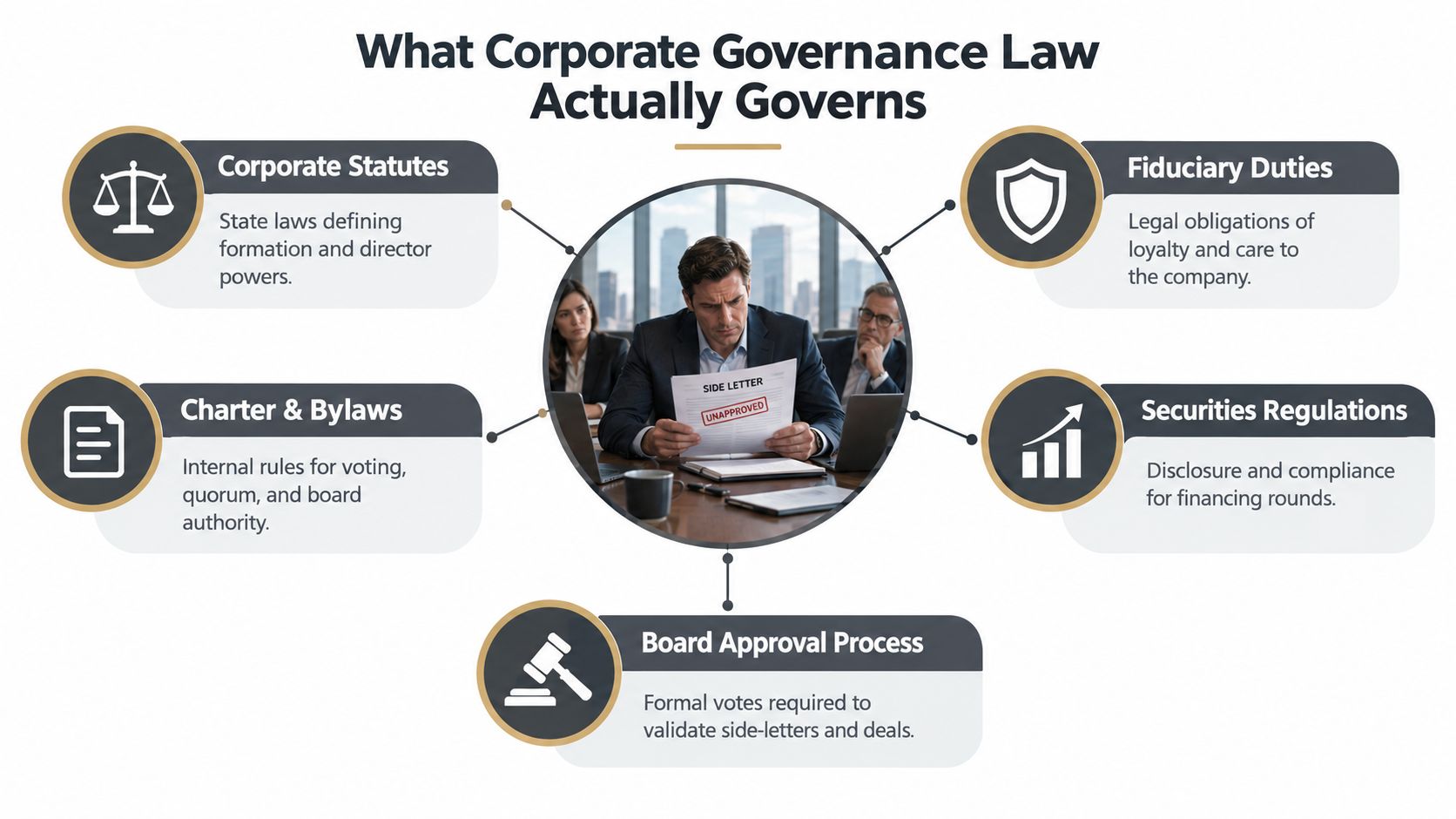
Corporate governance law allocates authority and accountability. State corporate statutes, such as the Delaware General Corporation Law and the Connecticut Business Corporation Act, establish the corporation's legal architecture. They address director powers, shareholder voting, records access, fiduciary obligations, indemnification, mergers, and derivative litigation.
The charter and bylaws then translate that architecture into the company's operating rules. A charter may establish classes of stock, voting rights, director protections, and limits on corporate powers. Bylaws typically address meetings, quorum, notice, elections, committees, officer roles, and amendment procedures. A board resolution supplies the formal approval for a specific action, such as issuing equity, entering a financing, approving a merger, or signing a related-party agreement.
Federal securities law enters when the company offers or trades securities. Public companies also face Securities and Exchange Commission disclosure rules and stock-exchange standards. For example, SEC rules require public companies to disclose audit committee independence and whether the company has an audit committee financial expert, while exchange rules add composition and qualification requirements. The SEC's audit committee disclosure rules illustrate how federal disclosure obligations interact with listing standards.
Practical rule: A transaction isn't properly governed merely because the right people agreed to it informally. The company must be able to show that the correct body had authority, received adequate information, followed the governing documents, and recorded its approval.
Corporate governance law also differs from commercial law. Commercial law governs the substance of a supply agreement, loan, employment contract, or acquisition document. Governance law asks whether the corporation had authority to enter that deal, whether the board approved it properly, whether a conflict existed, and whether the approval process protected the company.
ESG principles may influence investor expectations and corporate policies, but they aren't automatically binding law. Their legal force depends on statutes, regulations, exchange rules, disclosure obligations, contractual commitments, or adopted company policies. The broader legal framework continues to expand. The OECD reports that nearly 70% of its jurisdictions amended company law, securities law, or both during 2021–22, and that nearly two-thirds amended company law and/or securities law during 2023–24. The OECD Corporate Governance Factbook also reports that 60% of jurisdictions had sustainability assurance requirements in its 2025 materials. Governance now reaches disclosure credibility, sustainability information, and emerging technology risk, not just meeting formalities.
Fiduciary Duties Every Director and Officer Should Understand
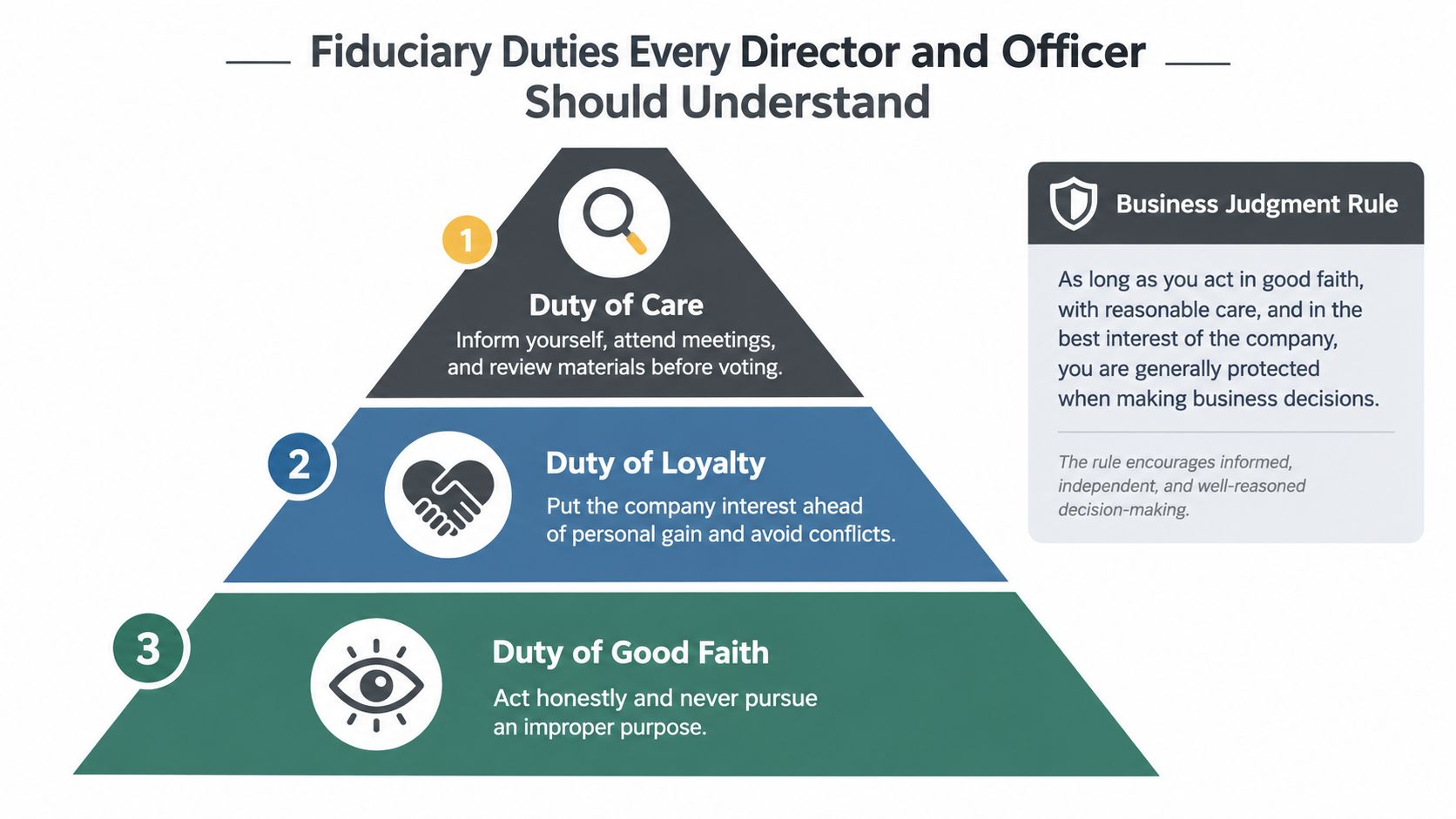
Directors usually encounter fiduciary duties in a predictable sequence: care before the decision, loyalty when interests collide, and good faith throughout the process. These duties protect the corporation, not a particular shareholder, founder, investor, or executive.
Duty of care starts with an informed decision
A director doesn't need to become an expert in every subject before voting. The director does need to understand the material facts, review the information reasonably available, attend meetings, ask questions, and make sure the board receives meaningful reporting about company operations and risks.
Suppose a board approves an acquisition after reading only management's presentation and never reviews the quality-of-earnings report. If the report contained material concerns that would have changed the board's analysis, the approval process may be difficult to defend. A board can rely on advisors, but reliance works best when directors understand the advice, identify obvious gaps, and document their consideration.
Loyalty requires conflict discipline
The duty of loyalty requires directors and officers to place the corporation's interests ahead of personal gain. A director who also sits on a key supplier's board has a potential conflict when the corporation negotiates with that supplier. Disclosure, recusal, disinterested approval, and a documented review of alternatives can make the difference between a defensible transaction and a litigation target.
The same concern applies to compensation, corporate opportunities, investments by insiders, and transactions involving family members or affiliated entities. A conflict policy can't cure every problem, but it gives the board a repeatable process for identifying and addressing one. For additional examples, review common breach of fiduciary duty scenarios.
Good faith is the baseline
Good faith requires honest action for a proper corporate purpose. Conscious disregard of known responsibilities, fraudulent conduct, or retaliation against a whistleblower can undermine the protections that ordinarily shield business decisions. The business judgment rule generally protects directors who act on an informed basis, without disabling conflicts, and in the honest belief that their decision serves the corporation.
Caremark oversight claims connect fiduciary attention to compliance and risk systems. The question isn't whether directors personally manage every operational issue. It's whether the board has made a good-faith effort to establish reporting systems, receive significant information, and respond when warning signs reach the boardroom.
Delaware Versus Connecticut Statutory Frameworks
A founder choosing between Delaware and Connecticut isn't selecting between a strong governance state and a weak one. Both regimes supply core corporate rules. The practical differences involve judicial predictability, drafting flexibility, litigation strategy, records access, fee exposure, and the expectations of investors or future public markets.
Delaware's DGCL is supported by an unusually deep body of Court of Chancery and Supreme Court decisions addressing fiduciary duties, entire fairness, mergers, exculpation, and corporate authority. Delaware also permits careful charter drafting under Section 102(b)(7), subject to statutory limits. Connecticut's BCCA follows modern business corporation principles and offers a workable framework for locally operated companies, but its litigation environment and case law are different.
| Issue | Delaware DGCL | Connecticut BCCA |
|---|---|---|
| Judicial framework | Deep, specialized corporate case law, particularly through the Court of Chancery | More limited corporate case law, with disputes handled through Connecticut courts |
| Fiduciary review | Detailed doctrines addressing business judgment, entire fairness, and conflicted transactions | Core duties and conflict rules exist, but drafting and litigation analysis may differ |
| Records access | Shareholders may pursue books and records demands under statutory procedures, including DGCL Section 220 | Shareholders have statutory inspection rights subject to applicable requirements |
| Forum selection | Delaware companies commonly draft exclusive forum provisions within statutory limits | Forum provisions require careful review under Connecticut law and the company's documents |
| Board structure | Flexible tools for classified boards, voting arrangements, and other governance features | Similar governance goals may be available, but statutory language and defaults must be checked |
| Officer protection | Charter drafting can address director and, where permitted, officer liability within statutory limits | Officer exculpation and protection require separate analysis under Connecticut provisions |
| Public-company committees | Exchange rules and federal securities requirements control many committee obligations | The same federal and exchange rules govern listed companies, regardless of state incorporation |
The choice also affects the relationship between governing law and other legal systems. A company negotiating employment arrangements across jurisdictions may need to analyze statutory rights in UK contracts separately from its corporate governance documents. The corporation's state of incorporation won't answer every employment, tax, securities, or commercial question.
Transparency rules add another drafting consideration. Delaware's corporate transparency framework and Connecticut's response to beneficial ownership reporting have developed against a changing federal backdrop. A company should confirm current filing and ownership-disclosure requirements rather than assume that its incorporation state resolves them.
For a Connecticut founder, Delaware may make sense when venture investors expect Delaware law, a national shareholder base is likely, or complex financing and exit planning justify the established case law. Connecticut may be sensible when the business, owners, and operations are closely tied to the state and the company values local administration. The right answer depends on the company's financing path, investor expectations, governance complexity, and tolerance for litigation cost.
Bylaws, Board Charters, and the Governance Document Toolkit
A governance document toolkit works only when its pieces fit together. The charter or articles sit at the top. They establish the corporation's foundational terms, including stock structure, voting rights, director protections, and other provisions that state law requires or permits.
Bylaws operate beneath the charter. They should answer practical questions before a dispute arises:
- Shareholder voting: Who may vote, how notice is delivered, and how votes are counted.
- Quorum and meetings: What permits the board or shareholders to conduct valid business.
- Director elections: How nominees are presented, elected, removed, or replaced.
- Amendments: Who can amend the bylaws and whether different classes or groups receive special rights.
- Committees: What committees may be formed and what authority can be delegated.
A board charter doesn't replace the bylaws. It turns broad governance responsibilities into an operating assignment. An audit committee charter can define responsibility for the external auditor relationship, financial reporting oversight, internal controls, complaint procedures, and committee reporting. A compensation committee charter can address executive pay, incentive plans, employment arrangements, and conflicts in compensation decisions.
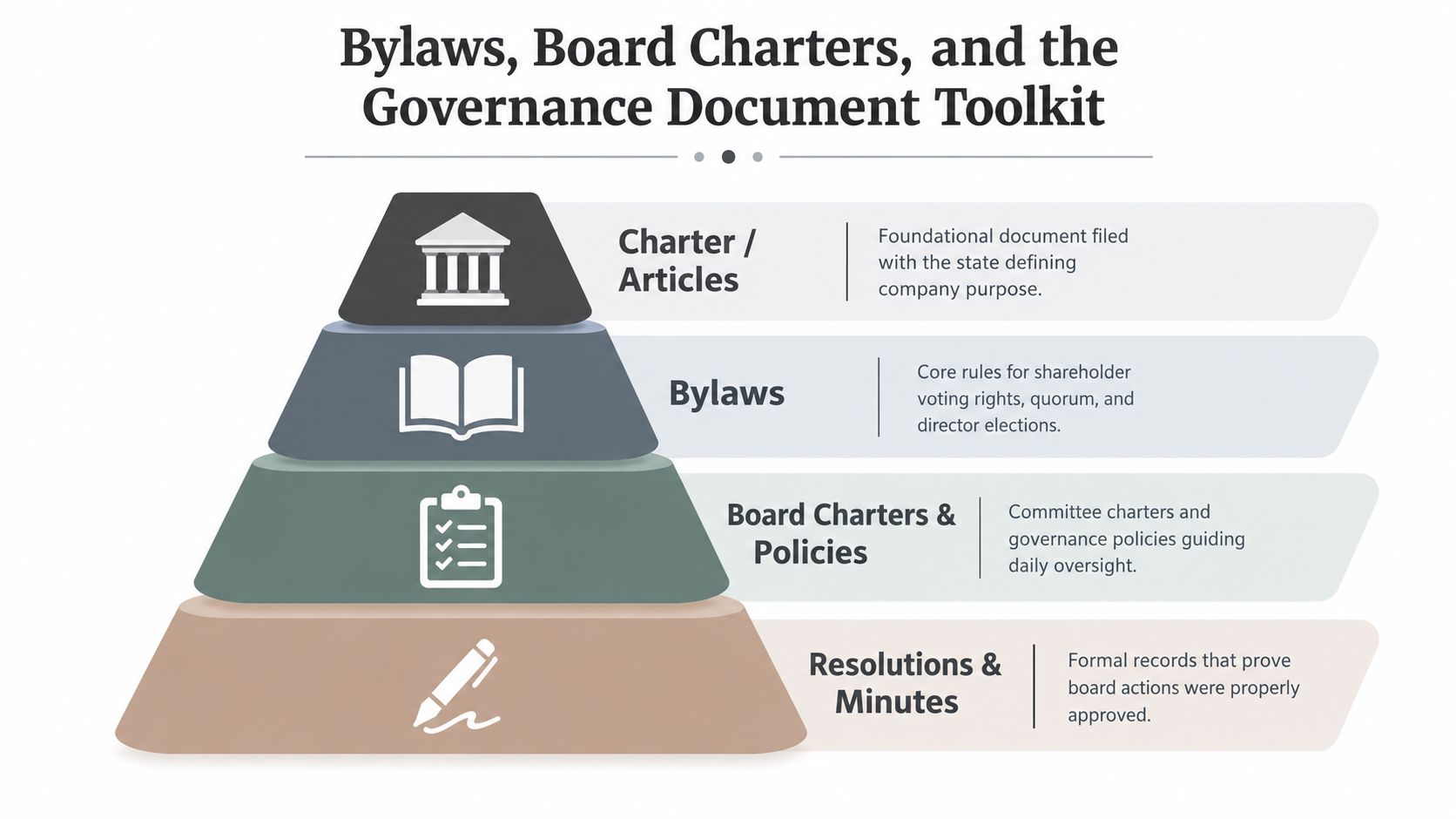
Policies fill the operational gaps. A conflict-of-interest policy tells directors and officers when to disclose a personal interest. An insider-trading policy controls trading windows and confidential information. A whistleblower policy creates reporting channels and anti-retaliation expectations. A code of ethics gives employees and executives a shared standard for conduct.
The final layer is the record of action. Board resolutions, written consents, committee reports, agendas, and minutes show what the board approved and what information it considered. A useful corporate resolution document guide can help identify when a formal resolution is appropriate.
Document discipline matters: A perfect bylaw won't rescue a company whose minutes don't show who approved the deal, what alternatives were considered, or how a conflict was handled.
Draft in sequence. Start with the charter and bylaws, then develop committee charters that match the authority those documents permit. Adopt policies that supplement, rather than contradict, the bylaws. Finally, use resolutions and minutes consistently. Overlapping documents create confusion when they assign different approval rights or define the same committee's responsibilities in incompatible ways.
Board Independence, Audit Committees, and Disclosure Obligations
Independence has both a legal meaning and an operational meaning. Legal independence asks whether a director has a relationship that disqualifies service under applicable law or exchange rules. Operational independence asks whether that director can challenge management, request additional information, and reject a favored proposal without fear of losing influence or compensation.
The OECD's G20/OECD Principles of Corporate Governance treat independent judgment as a structural control. The principles call for enough independent directors to handle conflicts, particularly on audit and remuneration committees. They also recognize that markets use different independence tests. The OECD materials identify substantial-shareholding thresholds ranging from 2% to 50%, with 10% to 15% the most common range among surveyed jurisdictions, as described in the G20/OECD Principles of Corporate Governance.
| Requirement | Source | Practical Effect |
|---|---|---|
| Audit committee independence disclosure | SEC rules and applicable exchange standards | The proxy statement must identify whether audit committee members are independent |
| Financial expert disclosure | Sarbanes-Oxley Sections 406 and 407, implemented through SEC rules | The company must state whether it has at least one audit committee financial expert, identify that person, and disclose independence from management |
| Audit committee size | NYSE listing standards | An NYSE-listed company must have an audit committee of at least three members |
| Exchange independence | NYSE standards and Exchange Act Rule 10A-3 | Audit committee members must satisfy both exchange and federal requirements |
| Cross-border independence | Market-specific corporate governance rules | A director may qualify in one market but fail another market's test |
The SEC's rules make the disclosure obligation concrete. Public companies must disclose audit committee independence in proxy statements, tied to the applicable listing standards. If there isn't a separate audit committee, the disclosure applies to the full board. The SEC also requires disclosure of whether the company has at least one audit committee financial expert and whether that expert is independent of management. NYSE-listed companies must maintain an audit committee with at least three members, and those members must satisfy NYSE independence standards and Rule 10A-3, as explained in the SEC order approving NYSE audit committee requirements.
Related-party transactions require the same discipline even before a dispute becomes litigation. Connecticut's interested-director rules and Delaware's entire fairness doctrine make disclosure, disinterested review, fair dealing, and fair price central to the analysis. A committee process can't guarantee approval, but it can improve the company's evidence that the board recognized the conflict and evaluated the transaction.
Shareholder Rights and Common Governance Disputes
Governance disputes usually begin with an ordinary business decision that leaves one shareholder outside the room. The legal remedy depends on the shareholder's rights, the company's documents, the board's process, and whether the challenged conduct harmed the corporation or the individual shareholder.
A co-founder may be excluded from operational decisions after the board withholds approval for a major contract. The founder may believe the board is using approval authority to force a personal concession. A books-and-records demand can test that theory by seeking minutes, board materials, communications, and records related to the decision. Delaware General Corporation Law Section 220 and Connecticut's corresponding inspection rights can provide a path to information, but the requesting shareholder must satisfy statutory requirements and identify a proper purpose.
A different dispute involves a director who approves a transaction with a portfolio company without disclosing the relationship. The corporation may later challenge the deal, and the director may face scrutiny over the approval process. Disclosure, recusal, independent review, and a fair record matter because courts may apply exacting review to conflicted transactions, including entire fairness analysis under Delaware law.
A missing approval is often more damaging than a difficult decision. The board may have had sound business reasons, but an incomplete record makes those reasons harder to prove.
A minority shareholder can face a more serious problem when a controlling stockholder pushes through a merger at an allegedly unfair price. Appraisal rights may provide a valuation remedy in qualifying transactions. Delaware's MFW protections can also matter when a controller conditions a transaction from the outset on approval by an independent special committee and a fully informed majority of the minority stockholders.
Shareholders have several recurring tools:
- Derivative actions: A shareholder sues on the corporation's behalf for harm to the company.
- Books and records demands: A shareholder seeks information to investigate suspected wrongdoing or prepare a related claim.
- Proxy access and voting arrangements: Investors use nomination, solicitation, or voting rights to influence board composition.
- Bylaw and agreement provisions: Governance documents allocate notice, forum, voting, consent, transfer, and dispute procedures.
Shareholder rights are shaped long before litigation. Clear bylaws, investor rights agreements, voting agreements, and conflict procedures can define expectations. Poorly coordinated documents create openings for the very disputes the board hoped to avoid. Founders managing minority ownership should review minority shareholder rights and remedies before a disagreement becomes a formal demand.
Compliance Best Practices and Steps to Strengthen Governance
A governance refresh should produce evidence, not just updated binders. The following first-100-days plan ties each action to a legal responsibility already present in the company's structure.
Establish the baseline
Start by comparing the charter, bylaws, board and committee charters, shareholder agreements, policies, and recent minutes against the company's actual practices. Look for mismatched share authorizations, obsolete officer titles, missing committee powers, inconsistent amendment provisions, and approvals that were handled informally.
Then confirm the governing law. A Delaware corporation should test its documents against the DGCL and Delaware judicial standards. A Connecticut corporation should review the BCCA, Connecticut inspection and interested-director provisions, and the company's actual shareholder and board practices.
Repair the approval system
Create a transaction matrix showing which decisions belong to management, the board, a committee, or the shareholders. Include financings, equity issuances, related-party transactions, major contracts, acquisitions, executive compensation, and side letters.
Adopt a fiduciary-duty acknowledgment for directors and officers. Pair it with a D&O questionnaire that asks about conflicts, affiliations, ownership interests, board service, and related parties. A questionnaire is useful only if someone reviews it before the meeting where the conflict matters.
Build reporting and records
Prepare a compliance calendar for meetings, notices, annual reports, proxy disclosures, committee reviews, and required filings. For public companies, calendar audit committee independence and financial-expert disclosures, along with exchange obligations.
Minutes should record the decision, participants, conflicts, materials reviewed, questions asked, advice received, and vote. They shouldn't become a transcript, but they must show a thoughtful process. When legal advice is needed, counsel should help the company create and preserve an appropriate privileged record.
AI oversight belongs on this calendar. Recent governance guidance identifies AI governance as one of the central corporate governance themes for 2026, while board survey data described in current corporate governance trends and developments places AI oversight lowest across more than 60 governance topics. Boards should address who owns AI risk, what uses require review, how vendors are evaluated, how errors are reported, and what disclosures are required. AI isn't merely an information-technology issue when it affects financial reporting, hiring, customer decisions, safety, privacy, or regulatory compliance.
The image above contains the practical sequence. The final step is ongoing review, not a one-time signature.
- Review governance documents: Correct gaps and contradictions.
- Clarify fiduciary duties: Train directors and officers using realistic transaction examples.
- Formalize approvals: Require resolutions or written consents for actions that need them.
- Schedule oversight: Put compliance, risk, conflicts, and AI review on recurring agendas.
- Preserve the record: Maintain accurate minutes, materials, questionnaires, and advice records.
Strong governance reduces exposure, but it doesn't eliminate fiduciary risk. Directors and officers still need appropriate insurance, advice of counsel, candid committee work, and disciplined minutes. For a broader review of recurring problems, see corporate governance issues and best practices.
If you want to discuss your business law matter, contact Kons Law at (860) 920-5181. Kons Law advises companies on formation, governing law, bylaws, fiduciary duties, board approvals, financing transactions, and compliance, and can help turn governance documents into a functioning decision process. Visit Kons Law to connect with counsel about your company's governance needs.
