You just found the problem. The equipment arrived, the software went live, or the contractor finished, and it does not do what you were told it would do. You pull the signed contract, search for the word warranty, and find either a short as is clause or nothing helpful at all.
That search misses most of contract law warranty risk. A warranty can come from a brochure, a spec sheet, a sample, or an email sent before signing. It can also come from the law itself, even when your contract says nothing. Once you know where warranties hide, you can decide which promises bind you, which ones help you, and what to fix before the next deal.
Warranty Types Compared at a Glance
A warranty is a promise about goods or services that becomes part of the deal, and if it's false, the buyer can claim breach. Use the table below as a quick lookup. Read Who it binds and Can it be disclaimed first, because those two columns tell you whether the promise applies to you and whether contract language can remove it.

Warranty types and what each requires
| Warranty | How it arises | Who it binds | Can it be disclaimed? |
|---|---|---|---|
| Express warranty | Affirmation of fact, promise, description or sample that becomes part of the bargain under UCC § 2-313 | Any seller making the statement | Only to the extent a disclaimer does not conflict with the express terms |
| Implied warranty of merchantability | A merchant sells goods that must be fit for ordinary purposes | Merchant sellers of goods | Yes, the disclaimer must mention merchantability and be conspicuous |
| Implied warranty of fitness for a particular purpose | Seller knows the buyer's special purpose and the buyer relies on the seller's judgment | Any seller, merchant or not | Yes, the disclaimer must be in writing and conspicuous |
| Title warranty | Seller promises good title and no undisclosed liens or claims under UCC § 2-312 | Seller of goods | Only by specific language or circumstances showing the buyer knew |
| Workmanlike performance | Implied in service contracts to perform with reasonable skill under common law | Service providers | Often limited by express terms and state rules |
Express warranties are the easiest to create by accident. A seller's factual statement in a specification, description, or sample can become enforceable even if nobody labels it a warranty. Buyers see the same pattern in consumer and construction deals when exclusions sit in fine print, which is why reviewing common exclusions in window warranties is a useful reminder to read what a warranty leaves out, not only what it covers.
Merchantability and fitness fill gaps when the contract is silent. Title warranty protects ownership, while workmanlike performance covers services under common law rather than the UCC.
The warranties that bind you most often are the ones nobody wrote down as warranties.
Ask a blunt question about your current contracts. Which of these could already exist, even if the word warranty never appears?
UCC, Common Law or CISG
Before you argue about a warranty, identify the legal framework that governs the deal. That sorting question changes the rules for what was promised, how a disclaimer works, and what remedy follows.
UCC, common law and CISG compared
| Framework | Scope | Warranty standard | Disclaimer approach |
|---|---|---|---|
| UCC Article 2 (US) | Sales of goods | Express warranties, merchantability, fitness and title | Conspicuous writing, merchantability must be named |
| Common law | Services, real estate and non-goods contracts | Implied terms, conditions versus warranties | Set by contract wording and state rules |
| CISG | Cross-border sales of goods between parties in different contracting states | One conformity duty under Article 35 | Parties may agree otherwise, Article 35(3) knowledge limit |
Start With What You Bought
In the United States, UCC Article 2 governs sales of goods. Furniture, machinery, inventory, and components usually fall here, so express and implied warranties for goods are the starting point. Common law governs services and non-goods contracts, such as consulting, construction services, and real estate. Courts there focus more on the parties' express terms, implied duties of reasonable performance, and the older distinction between conditions and warranties.
Mixed deals cause confusion. If you buy equipment plus installation, a court may ask which part predominates, goods or services. Don't leave that to a judge if you can state the governing framework and performance standard in the contract.
Cross-Border Sales Use Conformity
The United Nations Convention on Contracts for the International Sale of Goods, adopted in Vienna in 1980, uses a unified concept of conformity rather than separate domestic labels such as express warranty, merchantability, or fitness. Article 35(1) requires goods matching the contract's required quantity, quality, description, and packaging.
Unless the parties agree otherwise, Article 35(2) adds four baseline standards. Goods must be fit for ordinary purposes, fit for a particular purpose made known to the seller when the contract was concluded where the buyer reasonably relied on the seller's skill or judgment, consistent with any sample or model, and packaged in the customary or adequately protective manner. Article 35(3) limits liability where the buyer knew, or could not have been unaware, of the defect when the contract was formed.
Say a U.S. exporter sells machinery to a German buyer. The CISG may govern unless the contract expressly excludes it, so American assumptions about disclaimers may not control. The phrase except where the parties have agreed otherwise makes your specifications, exclusions, inspection terms, and remedies central.
Before signing, confirm three things.
- Governing law clause: Name the law that controls interpretation and disputes.
- CISG position: State clearly whether the CISG applies or is excluded.
- Warranty framework: Draft promises, disclaimers, and remedies to match that choice.
How Express Warranties Arise From Ordinary Statements
Say a dealer emails you a spec sheet before you buy a packaging machine. It says the machine handles 500 units per hour, your team plans staffing around that number, and the signed contract later says only that you're buying the machine as described. If the machine tops out well below that rate, does that email matter?
It can. Under Uniform Commercial Code § 2-313, an express warranty can arise from a seller's affirmation of fact or promise, a description of the goods, or a sample or model that becomes part of the basis of the bargain. No specific formal words such as warranty or guarantee are required. Product descriptions, specifications, demonstrations, and samples may create obligations even when the contract doesn't label them as warranties.

Where These Promises Hide
Look beyond the warranty clause. Spec sheets, product descriptions, demonstrations, samples, sales decks, proposal schedules, and negotiation emails can all contain factual commitments. A statement that equipment works with your existing system, meets a named standard, or includes specific components is different from sales enthusiasm.
Puffery is the boundary. Industry-leading and best in class usually read as opinion because a buyer can't test them against a clear standard. 500 units per hour is measurable, so a buyer can prove or disprove it. The more specific and factual the statement is, the more likely a court will treat it as more than advertising talk. If a seller crosses from opinion into a false factual claim, the analysis can also overlap with misrepresentation in a contract.
Test Every Statement Before Signing
Make a list of every factual representation made before signing. Note which ones influenced your decision to buy, then check whether the final document repeats, limits, or overrides them.
Ask three questions of each statement.
- Is it a fact about the goods: Can you measure it, test it, or compare it to a sample?
- Did the buyer rely on it: Did it affect price, selection, timing, or intended use?
- Does the final deal still mention it: Is it incorporated, contradicted, or left outside the signed papers?
Don't wait for a dispute to gather those papers. Inventory every spec, brochure, demo note, sample, and email before the contract is finalized, and decide on purpose which statements survive.
Implied Warranties That Apply Even When the Contract Is Silent
Implied warranties surprise business owners because nobody has to say them out loud. The law adds them to many sales of goods to set a basic floor for quality and suitability. If your contract doesn't address them, silence usually doesn't make them disappear.
The Cornell Legal Information Institute summary of implied warranty describes two important UCC warranties. The implied warranty of merchantability generally applies when a merchant sells goods and requires goods to be fit for their ordinary purpose and pass without objection in the trade under the contract description. The implied warranty of fitness for a particular purpose can arise when the seller has reason to know the buyer's special purpose and knows the buyer is relying on the seller's skill or judgment to select suitable goods, and it can apply even when the seller is not a merchant.
Merchantability Means Ordinary Use Works
Think about the normal job the product is supposed to do. A ladder's ordinary purpose is safe climbing within its rating. If a hardware store sells a ladder rated for ordinary climbing and it folds during normal use, the problem isn't that it failed some special request. It failed the basic use buyers expect.
Merchantability also looks at trade standards. Goods should pass without objection in the trade under the contract description, be adequately packaged and labeled as the agreement requires, and conform to promises on the container or label. A product can run and still be unmerchantable if defects make it unacceptable for ordinary buyers in that market.
Fitness Means the Seller Helped Choose for Your Use
Fitness is narrower and fact driven. Say a contractor tells a supplier, I need a coating that resists diesel fuel, and asks the supplier to pick the right product. The supplier recommends a coating that softens on contact with diesel. That's the classic fitness problem because the buyer communicated a special purpose and relied on the seller's judgment to select suitable goods.
This warranty can apply to a private seller who isn't a merchant, if that seller knows the purpose and the buyer relies on its judgment. That point matters in one-off equipment sales between businesses, where people assume only regular dealers give implied warranties. For service-heavy deals, separate goods terms from services terms, as explained in what is a service agreement.
Use three questions to sort it out.
- Is the seller a merchant: Merchant status is central to merchantability.
- Does the seller know the purpose: A special purpose must be communicated or reasonably known.
- Did the buyer rely on its judgment: Reliance separates casual advice from a fitness warranty.
If a special purpose matters, state it in writing before the sale so reliance is clear.
Buyers should describe the exact environment, materials, workload, and compatibility needs. Sellers should document when they're merely providing a product the buyer selected, not choosing it for the buyer's use. Those short records often decide the case later.
When Disclaimers Hold and When They Fail
Many owners treat as is as a magic phrase. It isn't. Courts examine the whole contract, how prominent the disclaimer is, what the buyer relied on, and what type of claim the buyer brings.

The Formal Rules Matter
A disclaimer of merchantability generally must mention that word, and a written disclaimer must be conspicuous. A disclaimer of fitness must be in writing and conspicuous. Language buried in dense boilerplate, printed in the same small type as everything else, invites a fight over whether the buyer fairly saw it.
A general as is phrase can exclude implied warranties in many goods sales, but it doesn't automatically cancel an express warranty made in the same deal. If your brochure promises a measurable result and the contract later tries to disclaim everything without addressing that promise, the conflict becomes the dispute. Similar clarity problems arise in home improvement work, where Superior Home Improvement explains workmanship warranties in terms of what workmanship coverage does and doesn't promise.
Merger or integration clauses add another layer. They say the signed agreement is the complete deal, which can cut off claims based on earlier oral or written statements. But the result depends on wording, governing law, and the claim pleaded. Fraud, statutory claims, rescission, and revocation don't always rise or fall with a warranty claim.
What One Court Did
In a 2025 Georgia Court of Appeals decision involving a used vehicle, merger, as-is, and warranty-disclaimer provisions defeated fraud and statutory claims based on alleged extra-contractual representations. The same language also prevented the buyer from proving UCC nonconformity for revocation. That outcome shows strong, specific language can work, but it doesn't prove every disclaimer will end every theory in every state.
That's especially important in equipment acquisitions, technology purchases, financial-services transactions, and practice-sale agreements. Projections, compliance descriptions, service levels, or asset lists shared before signing may be exactly what induced the deal. A careful contract should say which of those materials are relied on, which are not, and whether fraud or misrepresentation claims are carved out. Those choices also interact with limitation of liability in contracts, because a remedy cap can matter even when a warranty claim survives.
Ask three questions of any disclaimer.
- Which representations survive: Are brochures, proposals, samples, and emails inside or outside the agreement?
- Which remedies remain: Can the buyer still reject, revoke acceptance, seek damages, or pursue a statutory claim?
- What controls a conflict: Does the signed agreement override sales materials, and is that hierarchy unmistakable?
Before relying on an integration clause, check whether it covers your brochures and emails. Sellers should align sales materials with the contract. Buyers should refuse to let key promises live only outside the signed document.
Remedies for Breach and Drafting Terms That Control Them
A warranty is only as useful as the remedy behind it. If the goods fail, you need a process you can follow under pressure, not a vague promise to make things right.
Remedies for breach of warranty
| Remedy | When the buyer can use it | Source |
|---|---|---|
| Repair or replacement | Seller's agreed cure, enforceable as the exclusive remedy unless it fails of its essential purpose | UCC § 2-719 |
| Cover | Buyer buys substitute goods after rejection or seller's failure to deliver and recovers the extra cost | UCC § 2-712 |
| Damages for accepted nonconforming goods | Difference between value as warranted and value as delivered, plus incidental and consequential damages where not excluded | UCC § 2-714 |
| Rejection | Buyer refuses nonconforming goods within a reasonable time after delivery | UCC § 2-602 |
| Revocation of acceptance | Buyer undoes acceptance when the defect was hard to discover or the seller assured a cure | UCC § 2-608 |
| Price reduction | Proportional reduction for nonconforming goods in a cross-border sale | CISG Art. 50 |
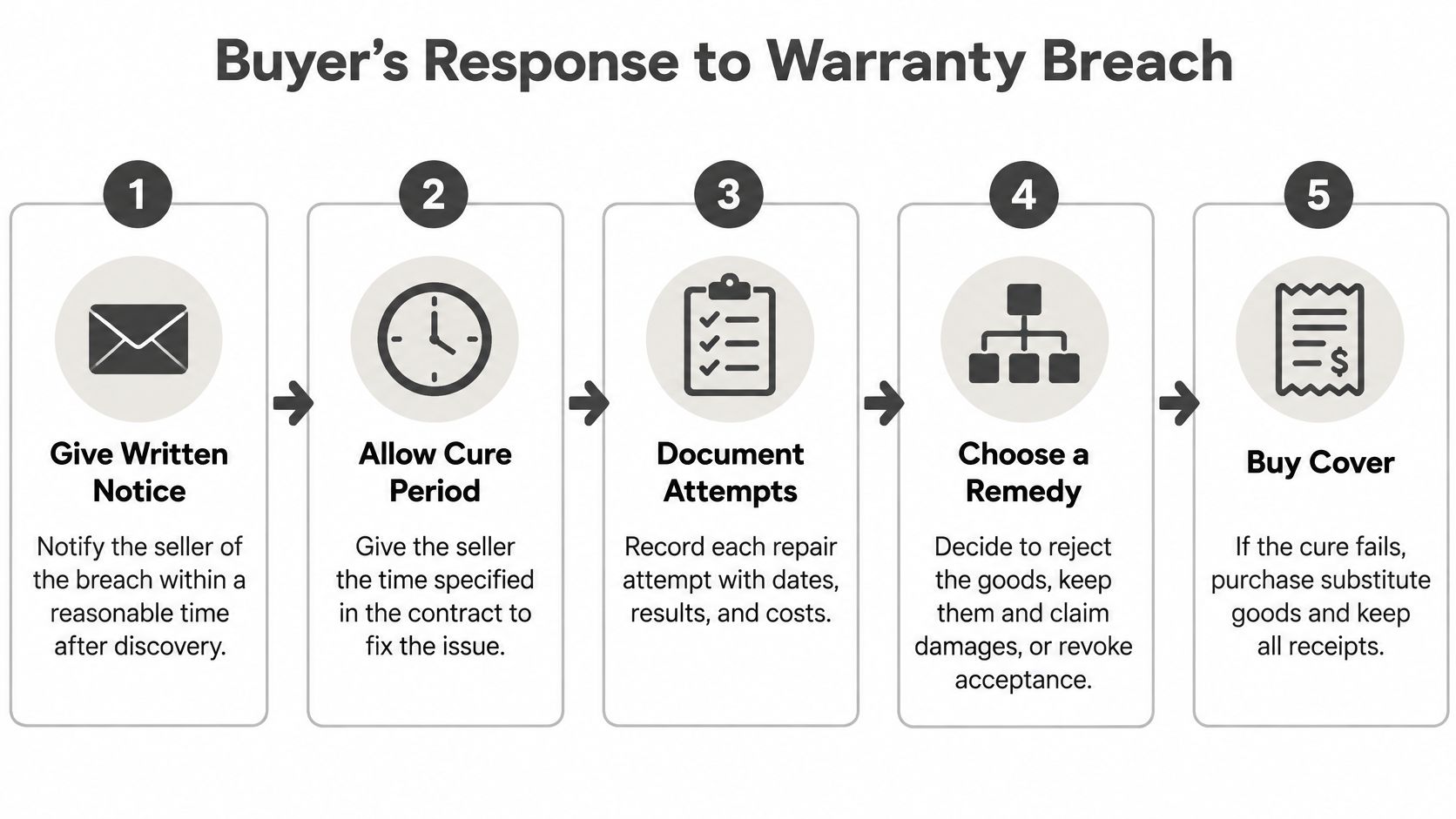
The Buyer Response in Five Steps
First, give written notice of breach within a reasonable time after discovery. Describe the defect, when you found it, and how it affects use. Second, allow the seller the cure period stated in the contract, even if you're frustrated. Skipping cure can weaken your position. Third, document each repair attempt with dates, results, downtime, and costs. Fourth, choose your path, reject the goods, keep them and claim damages, or revoke acceptance if the legal test fits. Fifth, if cure fails, buy cover where appropriate and keep receipts showing the substitute cost.
Timing controls many of these choices. Rejection usually must happen within a reasonable time after delivery and before acceptance. Revocation comes later, but it generally requires a defect that substantially impairs value and was hard to discover, or acceptance based on the seller's assurance of cure. Keep using defective goods for months without notice, and you may give the seller arguments you didn't need to create.
When Repair or Replace Is Not Enough
Parties often make repair or replacement the exclusive remedy and limit consequential damages. That bargain can hold, but an exclusive remedy can fail of its essential purpose after repeated unsuccessful repairs, unavailable replacement parts, or a fix that doesn't address the actual defect. The narrower the remedy, the greater the exposure if the seller can't perform it reliably.
Cross-border buyers should also notice the CISG price reduction remedy in the table. It lets the price track the reduced value of nonconforming goods, which can be cleaner than fighting over replacement across borders. For the broader menu after a broken promise, see breach of contract remedies.
Insurance doesn't replace contract remedies. A service business might separately evaluate professional liability cover for laser treatments, for example, but insurance responds to covered liability, while your contract still decides notice, cure, replacement, and damages between buyer and seller.
Draft the Remedy System Before You Need It
Use this checklist when you draft or review terms.
- Inventory statements: List factual claims from proposals, spec sheets, samples, and emails, then mark which survive signing.
- Set document hierarchy: State that the signed agreement and named schedules control over marketing materials.
- Name warranties given and disclaimed: Use conspicuous wording for merchantability and fitness, and avoid contradicting express promises.
- Define acceptance: Add measurable acceptance tests, inspection rights, and notice periods tied to discovery.
- Set cure and fallback: Specify cure time, repair versus replacement criteria, shipping and labor costs, exclusive remedy, and what happens if cure fails.
- Address fraud carve-outs: State how fraud and misrepresentation claims are treated, as far as the parties agree and governing law allows.
- Confirm governing law: Address UCC, common law, and whether the CISG is excluded in cross-border sales.
Our Commercial Transactions practice drafts and reviews contracts and advises on sales agreements, so these terms can be checked as a system rather than clause by clause. Keep limitation periods in view too, and calendar notice and filing deadlines as soon as a defect appears.
Check Your Warranty Terms With Kons Law
A warranty dispute usually starts long before the product fails. It starts when sales materials say one thing, the signed agreement says another, and the remedy clause assumes a repair process the seller may not be able to deliver. Reviewing those pieces together is how you find the gap while you can still fix it.
Kons Law's Commercial Transactions team drafts and reviews sales agreements and advises on warranty, disclaimer, and remedy terms. That review can cover which pre-signing statements survive, whether disclaimers are conspicuous and specific enough, how inspection and notice work, and what fallback applies if repair or replacement fails. For business owners, the goal is simple. Know which promises you're making, know which promises you're relying on, and make the contract prove both.
Don't send confidential or sensitive information to Kons Law until you've talked to an attorney and a written agreement letter establishing an attorney-client relationship is in place. Information sent without that relationship is not privileged, so start with a conversation rather than attachments.
If you want to discuss your business law matter, contact Kons Law at (860) 920-5181. This week, pull one current contract and check its warranty clause, disclaimer, integration clause, and remedy terms against the checklist above. Write down every sales statement the signed agreement doesn't address. That short list will show you where your next warranty argument is likely to begin.
If your brochures, proposals, or emails promise more than your signed contracts intend, we can help you align the documents before a buyer tests them. Visit Kons Law to connect with our Commercial Transactions team about warranty, disclaimer, and remedy terms for your next sale or purchase.
