You've received a demand for the remaining balance on a promissory note. The amount looks wrong, the deadline is close, and you're wondering whether your signature means there's nothing left to argue. If you're a financial advisor, you may also be weighing what a dispute will mean for your current firm, your registration, and your next move.
A promissory note default is a document-and-timeline problem, not a judgment about whether someone intended to repay. The practical questions are what triggered the demand, which procedures the holder followed, and how the holder calculated the balance.
What Counts as Default on a Promissory Note
Say an advisor leaves a broker-dealer in March. No installment was ever missed, but a demand arrives in April seeking the full unforgiven loan balance. The advisor's first reaction is understandable: How can a loan be in default when every required payment was made?
The answer starts with the note. A missed payment is only one possible default event. An employment-related condition can create repayment exposure even when the payment ledger is clean.
Different triggers require different proof
A payment default occurs when principal or interest remains unpaid beyond the applicable grace period. A maturity default occurs when the final payment or balloon comes due and isn't paid. Neither requires a dispute over employment status.
A nonpayment or technical default involves another contractual obligation. Examples include failing to deliver financial reports, breaching a financial covenant, defaulting on another identified obligation, or experiencing a defined insolvency event. In a recruiting-loan arrangement, resignation or termination may be the relevant trigger.
For a concrete example, Connecticut regulations governing certain regulated loans require the note to treat an installment unpaid 15 days after its due date as a default, permit acceleration, require an interest increase to 12% annually continuing after judgment, and authorize reasonable attorneys' fees and legal costs. Those are terms for the regulated loans covered by that provision, not a universal Connecticut grace period.
Practical rule: Don't assume the deadline in the demand letter is the same as the deadline in the contract.
Late, in default, and accelerated aren't interchangeable
Think of delinquency as late rent, default as the lease breach, and acceleration as a demand for the remaining year's rent at once. That analogy explains the distinction, not whether a particular landlord could enforce such a demand.
Acceleration moves a future payment obligation into the present. Whether it happens automatically or requires an election and notice is a separate question from whether a default occurred.
Locate these provisions before evaluating the demand:
- Events of default: Identify the exact event the holder alleges.
- Notice and cure: Check delivery requirements and any opportunity to fix the breach.
- Acceleration: Determine what makes the remaining balance immediately payable.
Default Triggers and What Each One Sets in Motion
A missed payment, an expired maturity date, or a job change can each trigger a different contractual response. The note determines the trigger, the time to cure, and what the holder may demand next. Treat the demand as a calculation tied to those terms, not as proof that every amount claimed is due.
| Default trigger | Typical notice or cure window | Does the balance accelerate? | Added cost or remedy activated |
|---|---|---|---|
| Missed installment of principal or interest | The note's grace period; for the Connecticut regulated-loan example, 15 days after the due date | Yes, if the note permits acceleration on payment default | Default interest under the applicable terms, reasonable attorneys' fees and legal costs |
| Maturity or balloon date passes unpaid | Ordinarily no additional grace period unless the documents provide one | Remaining principal and accrued interest are already due | Permitted post-maturity or post-judgment interest; collection suit |
| Covenant breach involving reporting, financial ratios, or insurance | The notice-and-cure clause sets the deadline; some breaches may be incurable | Yes, if authorized after the required cure opportunity | Acceleration, authorized fees, possible collateral enforcement |
| Cross-default to another obligation | The linked agreement's cure period and the cross-default clause control | Yes, if the clause covers that obligation and event | Additional balances may accelerate; guaranty claims may follow |
| Insolvency or bankruptcy filing | Clauses often purport to operate immediately; bankruptcy law can limit enforcement | The contract may provide for acceleration, subject to bankruptcy law | An automatic stay may halt collection; a secured creditor may seek stay relief |
| Resignation or transfer to another firm | The separation date or repayment deadline specified in the note | Unforgiven principal may become immediately due | Contractual interest, authorized collection expenses, FINRA arbitration |
| Termination by the firm, with or without cause | The note's termination and notice provisions set the rule | Disputed when the separation event falls outside the acceleration language | Forgiveness-credit disputes, offsets, counterclaims |
| Failure to meet revenue or registration conditions | The contractual measurement or forgiveness date | All or part of the repayment obligation may become payable | Repayment of the affected advance |
Acceleration and interest require separate calculations
Acceleration changes when principal is due. Default interest changes its carrying cost. A demand that combines both into one unexplained total is difficult to assess. Separate the principal that became due from interest charged for each period.
Written notice may be required before acceleration, although some notes waive notice to the extent legally permitted. Compare the required delivery method, recipient, address, and cure deadline with the contract. The acceleration clause in a promissory note determines whether future installments can be made payable immediately and what steps the holder must take.
For a hypothetical balance of $200,000 at the Connecticut example's annual rate, simple interest would be approximately $24,000 per year, assuming no payments, compounding, or changes to principal. This illustrates the carrying cost; it does not establish the amount recoverable in a particular dispute.
Fees, collateral, and related obligations
A contract that authorizes attorneys' fees does not make every invoice recoverable. Check the contractual basis for the charge and whether the amount requested is reasonable. Also look for collection expenses that duplicate another charge.
Collateral may give the creditor a route to recovery alongside a money claim, subject to the security documents and applicable law. Cross-default provisions and guaranties can widen the dispute. A guarantor's liability still depends on the guaranty's own trigger and limits.
Consumer-loan rules do not automatically apply to a commercial recruiting note. Short-term consumer borrowing presents a different set of questions, addressed in this guide to borrower rights when payday loans default.
Rebuild the demand line by line: accelerated principal, credited forgiveness, payments, interest by period, and authorized fees. For regulated financial professionals, the gap between a demand and an award can carry consequences beyond the disputed balance. Ignoring a claim may turn an arguable debt into a licensing problem, so track response deadlines and participate in the required process.
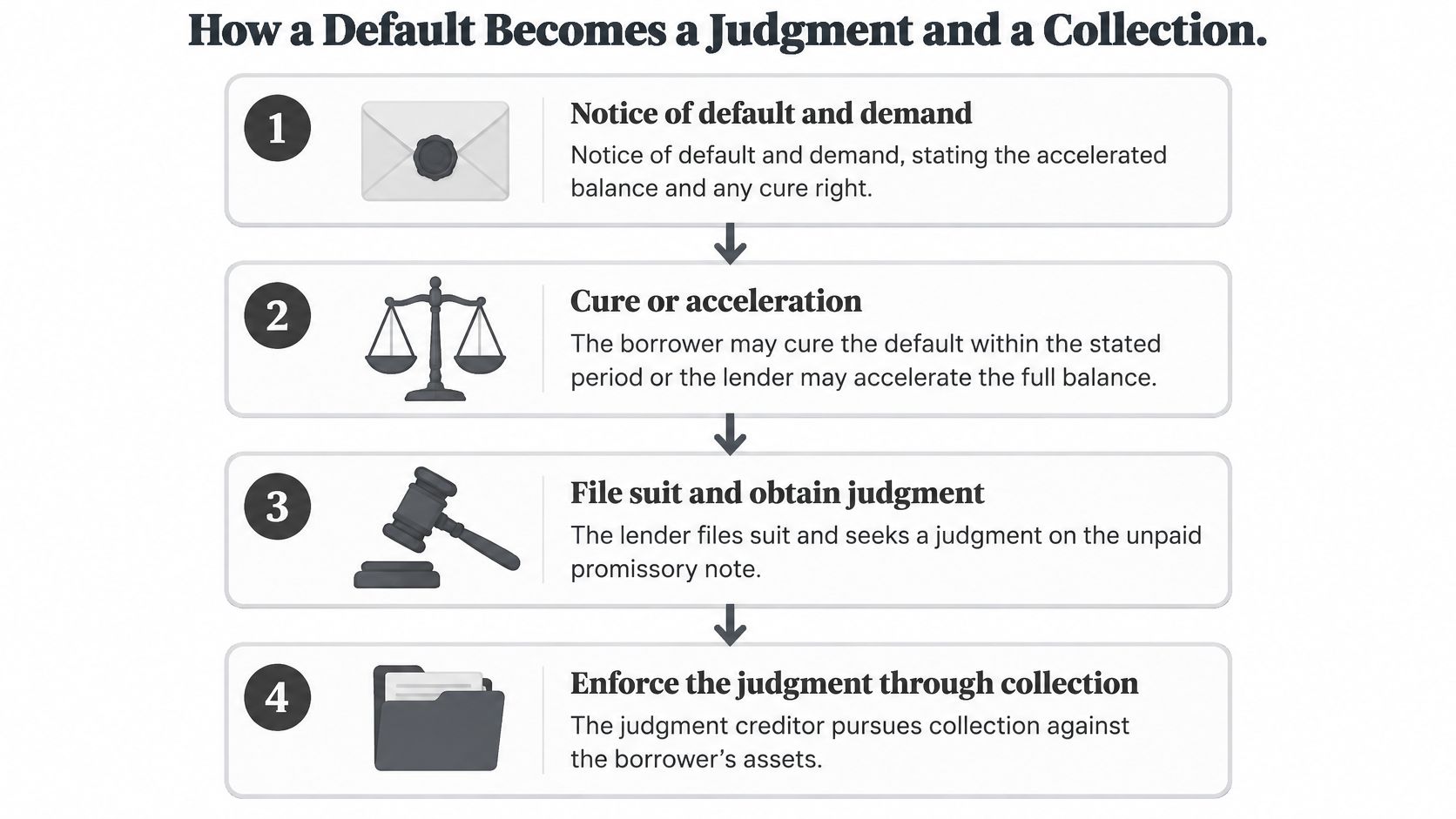
How a Default Becomes a Judgment and a Collection
A demand isn't a judgment, and a judgment isn't cash recovered. Each stage requires its own documents and decisions.
Identify the stage before choosing a response
Notice of default and demand. The holder identifies the alleged breach, claimed balance, and any cure right. Preserve the envelope, delivery confirmation, and attachments, because receipt and delivery can become disputed facts.
Cure or negotiation. A forbearance agreement can postpone enforcement while the borrower follows an agreed schedule. A standstill buys time, but read any acknowledgment, release, added collateral requirement, or waiver before signing.
Suit or arbitration filing. The holder files in the required forum, which may be court or industry arbitration. If the claimant isn't the original lender, request evidence showing how and when it acquired enforcement rights.
Answer, defenses, and counterclaims. Respond to the pleaded allegations rather than merely sending another settlement proposal. Identify any offsets and related claims early enough to preserve them under the applicable procedure.
Judgment or award. The decision establishes an enforceable obligation, subject to available review and other legal limitations. Settlement remains possible, but the parties' bargaining positions have changed.
Post-judgment enforcement. Available tools may include wage garnishment, bank levies, property liens, and asset discovery, subject to exemptions and jurisdictional restrictions. Effective judgment enforcement requires identifying reachable assets rather than assuming every asset is collectible.
Collateral enforcement in parallel. Under Connecticut's Uniform Commercial Code § 42a-9-601, a secured party may reduce its claim to judgment, foreclose, or otherwise enforce its claim or security interest through available judicial procedures, subject to statutory and contractual limitations. Review the security agreement, collateral description, attachment, perfection, filing status, priority, default provisions, and waiver or cure rights.
Recovery value drives settlement decisions
An unsecured holder has no contractual security interest in specified collateral merely because it owns the note. That holder may accept a discount a properly perfected secured creditor would reject, particularly where assets are scarce.
Transfers also change who is making the collection decision. Readers evaluating that market can browse distressed note opportunities through LendingXpress, but a purchaser still needs to evaluate enforceability, priority, and recoverability.
A strong paper claim and a collectible claim aren't necessarily the same thing.
Interest and authorized expenses can increase during the dispute. Early resolution often costs less, but not if it means paying an unaudited balance or surrendering valuable defenses.
Why Broker Transition Notes Default Without a Missed Payment
A transition loan often functions like a signing bonus paid early and earned over time. The firm advances cash, the representative signs a note, and the firm forgives scheduled portions if the representative satisfies the agreed conditions.
The distinction matters at departure. An advisor may regard the advance as compensation already earned, while the documents treat the unforgiven portion as debt.
Forgiveness is conditional compensation
In the SEC administrative proceeding involving Verus Capital Partners, promissory notes tied forgiveness to continued registration with the sponsoring broker-dealer and imposed revenue-target and duration-of-association conditions. Failure to satisfy those conditions could require repayment of all or part of the amount owed.
That structure makes forgivable a description of the repayment mechanism, not a promise that every departure results in forgiveness. Continued employment alone may not satisfy a note that also requires production or registration milestones.
Consider a hypothetical $300,000 note forgiven over five years at $60,000 annually, with forgiveness occurring only on completed anniversaries. Departure in month 30 would leave $180,000 exposed before interest and fees because only two annual installments have been forgiven. A disputed annual production credit could change the claimed principal by $60,000 under those assumed terms.
The result changes if the contract provides monthly vesting, partial-year credit, or special treatment for certain exits. Don't substitute the recruiter's shorthand for the signed schedule.
Read the transaction as a whole
The note may contain the repayment obligation while another agreement defines eligibility for forgiveness. Review the documents together:
- Promissory note: Principal, interest, default events, and acceleration.
- Employment or representative agreement: Compensation obligations and separation rights.
- Repayment and forgiveness schedule: Anniversary dates, production tests, and credits.
- Termination provisions: Treatment of resignation, discharge, disability, or other exits.
- Arbitration provisions: Incorporated rules, forum, and procedural requirements.
A compensation dispute over withheld production credits may therefore affect the repayment calculation without eliminating the note itself. Preserve the statements showing how the firm calculated those credits, not just the final balance it reported.
There's also a separate regulatory boundary. The Federal Register's description of FINRA Rule 3240 explains that registered persons generally may not borrow from or lend to customers, subject to specified exceptions. A firm-funded transition loan must be distinguished from a customer-lending arrangement.
Before planning a departure, identify the exact forgiveness anniversary dates and every condition attached to them. A calendar entry based on the recruiting conversation is no substitute for the contractual date.
Defenses That Change the Number Owed
Termination without cause doesn't automatically erase a recruiting-loan balance. It does require a closer look at whether the firm triggered repayment properly, withheld a credit, or created a separate claim that reduces recovery.
The FINRA expedited decision involving Silvio Borrero illustrates why separation-related arguments and note liability require careful procedural treatment. The useful question isn't whether the advisor was fired, but what the agreements and evidence establish.
Separation events and the defenses each one supports
| Separation event | Argument it supports | Evidence to preserve |
|---|---|---|
| Voluntary resignation to join another firm | Often a weaker liability defense; examine uncredited forgiveness, interest, and unauthorized fees | Forgiveness schedule, payment history, production statements |
| Termination for cause | Whether the stated cause meets the contractual definition and activates acceleration | Termination letter, reviews, compliance file, Form U5 wording |
| Termination without cause | Improper interruption of forgiveness; prevention-of-performance or implied-covenant arguments; compensation offsets | Termination clause, recruiting promises, compensation records |
| Termination after a complaint or performance dispute | Retaliation or pretext, disputed production credits, potentially applicable whistleblower claims | Complaint correspondence, investigation records, event timeline |
| Disability or death | Contractual forgiveness, waiver, or applicable insurance discharge | Disability or estate records, relevant note clause, credit-life policy |
| Firm closure or acquisition | Inability to maintain required registration; successor's enforcement rights | Closure notices, assignment documents, registration records |
| Regulatory termination or statutory disqualification | Whether the event is a defined default; accuracy of separation disclosures | Regulatory correspondence, Form U5 filings, examination findings |
| Negotiated transition to a new firm | Payoff, novation, release, or new-firm arrangements may cap or shift repayment | Payoff agreement, release, new firm's transition terms |
Challenge the trigger and the calculation separately
Trigger defenses ask whether this separation event fits the language authorizing repayment. A clause addressing voluntary resignation shouldn't be treated as though it necessarily addresses every employer-initiated termination.
Another question is whether the firm prevented performance of a condition it was obligated to permit. That argument requires more than disappointment about losing future forgiveness; it needs contractual language and supporting facts.
Amount defenses address the ledger. Look for omitted production-based forgiveness, misapplied payments, interest charged over the wrong period, and fees lacking contractual support or reasonable documentation.
Preserve related claims deliberately
Withheld bonuses, deferred compensation, unpaid production credits, wrongful termination, and potentially actionable Form U5 statements may support offsets or counterclaims. None should be assumed valid merely because the advisor disputes the termination.
The firm may prove a note balance while the advisor proves a separate compensation claim. Keeping those theories distinct makes the requested reduction easier to explain and substantiate.
Other enforceability questions include limitations periods, defective notice, omitted cure opportunities, claimant standing, and terms challenged as unconscionable or unlawful penalties. These are legal issues to test against the governing law, not labels to add indiscriminately to an answer.
Preserve first: Keep recruiting communications, compensation statements, performance conditions, termination explanations, and account-crediting records through lawful channels.
Don't remove confidential customer information or firm records you aren't entitled to possess. Counsel can identify appropriate preservation and discovery methods.
FINRA's expedited note procedure is narrow. Related defenses and counterclaims need deliberate procedural handling rather than an assumption that the decision-maker will consider every aspect of the employment relationship automatically.
The FINRA Clock and the Cost of Ignoring a Claim
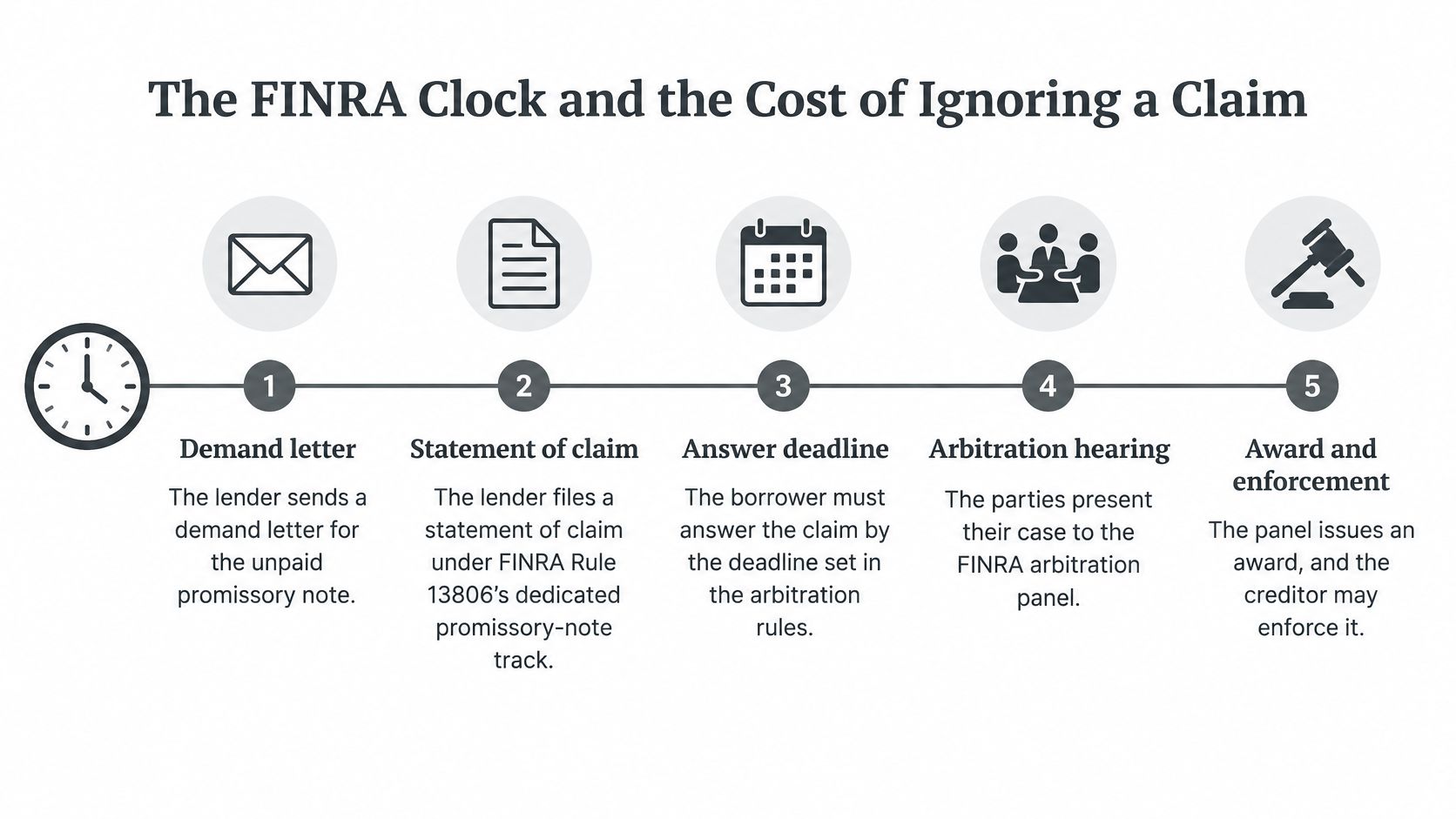
The most damaging interval may be the time between receiving a demand and responding to the arbitration claim. An advisor who has a plausible defense can still lose the opportunity to present it effectively by treating formal papers as another collection letter.
Track the procedural sequence
The relevant path is demand, statement of claim, answer deadline, hearing or other permitted disposition, award, and compliance or enforcement. Settlement can occur along that path, but negotiations don't automatically suspend procedural deadlines.
The New York court decision addressing FINRA promissory-note procedures discusses Rule 13806's dedicated note procedure and Rule 13807's expedited process when an associated person fails to answer. Determine which procedure applies before assuming there will be a conventional hearing.
Use the actual service materials and governing rules to calendar the response. A general description of the FINRA arbitration process helps orient the dispute, but it doesn't replace the deadline attached to the proceeding.
An unpaid award creates a different risk
A disputed debt and a final unpaid arbitration award aren't interchangeable. FINRA's post-award compliance process can affect an advisor's ability to remain associated with a member firm, not merely the advisor's finances.
As described in Kons Law's discussion of promissory-note enforcement, a 2026 FINRA decision required continued suspension unless the respondent paid, entered a written settlement and stayed current, or filed for bankruptcy protection, under the award-compliance framework involving Rule 9554. Those were the specified exits in that decision, not a guarantee that every respondent has identical procedural options.
Ignoring an arguable claim is usually worse than negotiating an imperfect resolution. Nonparticipation can produce an adverse award, after which the advisor faces compliance consequences rather than a debate about the original contract.
During the gap before an award:
- Protect deadlines: Respond while settlement discussions continue unless an effective extension applies.
- Evaluate the whole dispute: Identify offsets, counterclaims, and separation-related issues early.
- Make settlement workable: Put the release, payment schedule, interest treatment, and consequences of default in writing.
- Coordinate carefully: Evaluate confidentiality, Form U5 implications, and necessary communications with a current or prospective firm.
- Get bankruptcy advice: Don't assume a filing automatically resolves every contractual, regulatory, or career consequence.
A settlement payment the advisor can't realistically make may only postpone the problem. Defaulting on the settlement can reactivate award-compliance consequences, so affordability matters as much as the negotiated discount.
When the Note Was the Problem Rather Than the Borrower
A missed payment may be the visible default, but the underlying problem can start earlier: the issuer promised repayment without assets or other support sufficient to make that promise credible. A signed note establishes an obligation. It does not, by itself, establish that the borrower can pay or that the noteholder can recover.
The June 1, 2000 enforcement announcement described coordinated actions by the SEC and state securities regulators in 28 states involving more than 3,000 investors. The SEC separately filed 13 actions against 38 individuals and 22 entities over allegedly fraudulent promissory-note sales. Regulators alleged that the defendants obtained hundreds of millions of dollars from investors.
Repayment support matters more than reassuring language
A note may offer little practical protection if the issuer lacks insurance, collateral, or another reliable source of repayment. Even when support exists, its value depends on whether it is sufficient to cover the obligation.
Check any guarantee against the documents and the guarantor's ability to pay. Identify who signed, which obligations are covered, and whether the guarantor has resources that can be reached. A guarantee from an insolvent entity may add little recovery value.
When a note was marketed to investors, the circumstances of its issuance may raise securities-law issues alongside ordinary contract claims. The label note does not confine the dispute to collection.
Use credit benchmarks without overstating them
The Federal Reserve's FRED business-loan delinquency series reports quarterly percentages for business loans at all U.S. commercial banks. The cited series runs from January 1987 through April 2025 and draws from the Federal Reserve's Charge-Off and Delinquency Rates on Loans and Leases release.
Those figures provide context about commercial credit, not a forecast for a privately held promissory note. They don't directly measure privately held promissory-note defaults or the likelihood of collecting a particular recruiting loan or private investment note.
For an individual dispute, focus on the record that governs the debt:
- Performance records: Payment history, maturity dates, and documented covenant breaches.
- Recovery support: Current collateral value, lien priority, and guarantor resources.
- Balance support: Permitted acceleration, applicable interest, credited payments, and authorized expenses.
A noteholder should assess repayment support and the evidence before committing heavily to enforcement. A borrower should examine the same documents and timeline before conceding liability or the amount demanded.
Your Next Move After a Default Demand
Start with actions that preserve options rather than statements that concede the debt.
Don't sign a new acknowledgment yet. A payoff acknowledgment, confession of judgment, or replacement note may add obligations or waive defenses. Audit the balance before agreeing that it's correct.
Assemble the complete document set. Collect the note, amendments, employment or representative agreement, forgiveness schedule, termination letter, payment records, production statements, and recruiting communications. Keep the demand and proof of delivery with them.
Rebuild the claimed balance. Separate accelerated principal, earned forgiveness, payments, interest periods, and fees. Flag every entry you can't verify and identify the document that should support it.
Calendar the response deadline. Determine whether you face a court answer date, FINRA deadline, or contractual cure period. Silence can create consequences that are difficult or impossible to reverse, even when the underlying claim is contestable.
Review connected claims together. Evaluate the note, separation facts, and compensation issues as one transaction. A narrow review of the signature page can miss the facts that change repayment exposure.
For a business or lender seeking payment, the analysis runs in reverse. Demand strategy, settlement, litigation, and enforcement form a sequence, with opportunities to resolve the matter before additional expense is justified.
Kons Law's Debt Collection practice handles demand letters, negotiated settlements, litigation, and judgment enforcement for businesses, lenders, and creditors. Visit Kons Law to discuss a promissory-note demand, repayment dispute, or collection strategy. If you want to discuss your business law matter, contact Kons Law at (860) 920-5181.
