A supplier misses a delivery that your customers were counting on. A business partner stops performing but insists the contract gives them more time. A financial advisor leaves a firm, takes client relationships, and disputes a promissory note or deferred compensation. Within days, a commercial problem becomes a question of evidence, bargaining power, cash flow, and business continuity.
The first instinct is often to ask whether you can sue. The better question is broader: what result does the business need, what does the contract require, and which path can produce that result without creating a larger problem? Settlement, arbitration, court litigation, and post-judgment enforcement each serve different purposes. Contract dispute litigation is one tool in that decision, not an automatic destination.
When a Signed Deal Goes Sideways
Consider a manufacturer that signs a supply agreement with a critical vendor. The contract contains delivery dates, quality requirements, a notice provision, and a limitation on damages. The vendor misses an initial shipment, offers an informal explanation, and promises to catch up. The buyer keeps the relationship alive because switching suppliers would disrupt production. Later shipments arrive late and incomplete, and the buyer begins purchasing replacement goods at higher prices.
At that point, several disputes may exist at once. Did the vendor breach a material obligation? Did the buyer give the required notice and opportunity to cure? Were the replacement purchases commercially reasonable? Did the buyer mitigate its losses? Does the contract limit consequential damages or require arbitration?
A similar pattern appears in professional services. An advisor departs, takes confidential business information, contacts clients, and claims unpaid incentive compensation. The firm may want an immediate injunction, while the advisor may need records and payment before agreeing to resolve the dispute. Filing a complaint might preserve an advantage, but it can also alert clients, consume management time, and harden positions.
The decision starts before the complaint
The most useful early work is factual, not theatrical. Collect the signed agreement and every amendment, identify the governing-law and dispute-resolution provisions, preserve emails and text messages, and build a chronology that separates promises from performance. Then ask what outcome matters most:
- Continuity: Can the relationship be repaired with a cure plan, revised milestones, or a written amendment?
- Recovery: Can the business prove the amount of its loss and collect it from an identifiable counterparty?
- Protection: Does it need immediate relief involving confidential information, client contact, collateral, or ongoing conduct?
- Exit: Would a negotiated separation cost less than preserving a relationship that no longer works?
A demand letter can frame these issues without immediately committing the business to a lawsuit. It should identify the relevant obligation, explain the alleged breach, state the requested cure or payment, and preserve contractual and legal rights. Businesses considering that step can review this practical guide on responding to a demand letter.
Practical rule: Don't threaten a remedy you aren't prepared to pursue, and don't make a demand without first checking notice, cure, limitations, and forum provisions.
What Contract Dispute Litigation Is
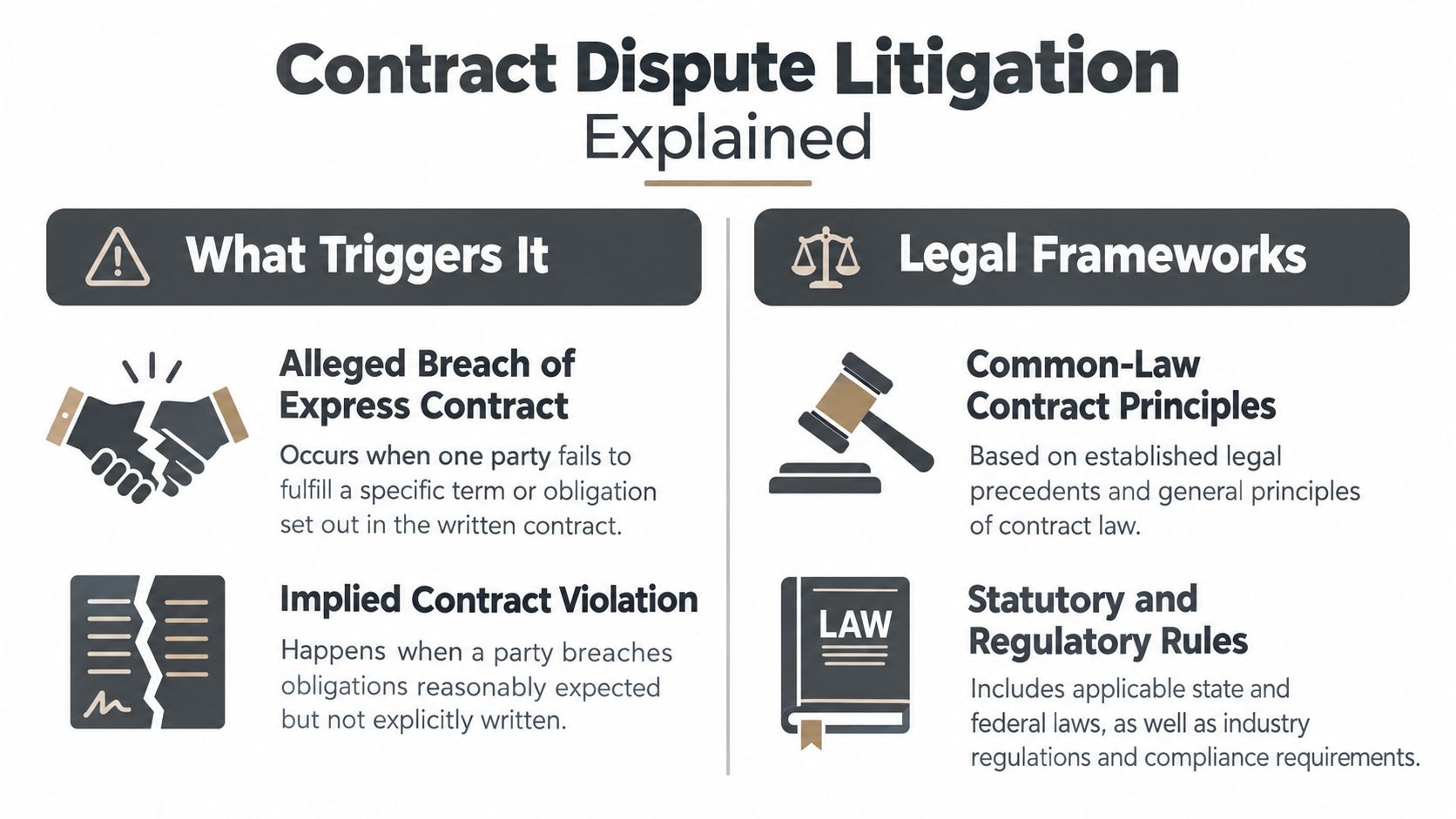
Contract dispute litigation is the court process used to resolve an alleged breach of an express or implied agreement. The dispute may involve nonpayment, defective performance, delayed delivery, repudiation, confidentiality, restrictive covenants, compensation, or a failure to follow a required process. The court is not deciding who feels mistreated. It looks at the deal the parties made, the law that fills gaps, what each side did, and what remedies the contract and governing law allow.
For businesses, the first question is usually not whether a breach occurred in the abstract. It is whether the contract can be enforced in a way that still makes financial sense.
Common-law contract rules usually govern services, employment-related agreements, partnership arrangements, licensing, and many other commercial relationships. Transactions involving goods may also implicate Article 2 of the Uniform Commercial Code, which addresses acceptance, warranties, cover, market damages, and consequential loss.
The contract may be formed across several documents
Commercial parties often assume there is no contract because a purchase order, confirmation, proposal, and invoice use different language. Under UCC § 2-207, a definite and seasonable acceptance or written confirmation can create a contract even when the response includes additional or different terms, unless the response is expressly conditioned on agreement to those terms. Between merchants, additional terms may become part of the contract unless the offer limits acceptance, the term materially alters the deal, or the recipient objects within a reasonable time. Conduct that shows both sides proceeded as if a deal existed can also establish a contract when the writings do not fully do so. A practical explanation appears in this UCC § 2-207 discussion.
Forum choice changes power. A claim may proceed in state court, federal district court, or a specialized commercial forum where one exists, and the right venue depends on the contract, the parties, the place of the conduct, the amount and nature of the claim, jurisdictional rules, and available remedies. Arbitration and mediation serve different purposes. Arbitration is a private adjudication before an arbitrator or panel. Mediation uses a neutral to help the parties reach their own agreement.
| Forum | Typical trigger | Key advantage | Key trade-off |
|---|---|---|---|
| State court | State-law contract claim or local business dispute | Broad procedural tools and court-backed remedies | Public record, formal motion practice, and potentially lengthy discovery |
| Federal court | Federal jurisdiction, including qualifying disputes between parties from different states | Federal procedures and access to federal judicial authority | Jurisdictional requirements and substantial procedural complexity |
| Arbitration | A valid arbitration clause or later agreement | Private process and the ability to select a decision-maker | Limited appellate review and potentially narrower discovery |
| Mediation | Parties want negotiated resolution | Flexible, confidential settlement process | No binding result unless the parties sign an agreement |
The Uniform Commercial Code replaced inconsistent sales rules with a shared commercial framework. Even so, each state's enacted text and case law still has to be checked before a business relies on it. That point matters in Connecticut as much as anywhere else, because a clause that looks routine on paper can play out differently once a judge, arbitrator, or mediator applies the governing law. Businesses considering a claim can also review this overview of suing for breach of contract.
The Lifecycle of a Contract Lawsuit
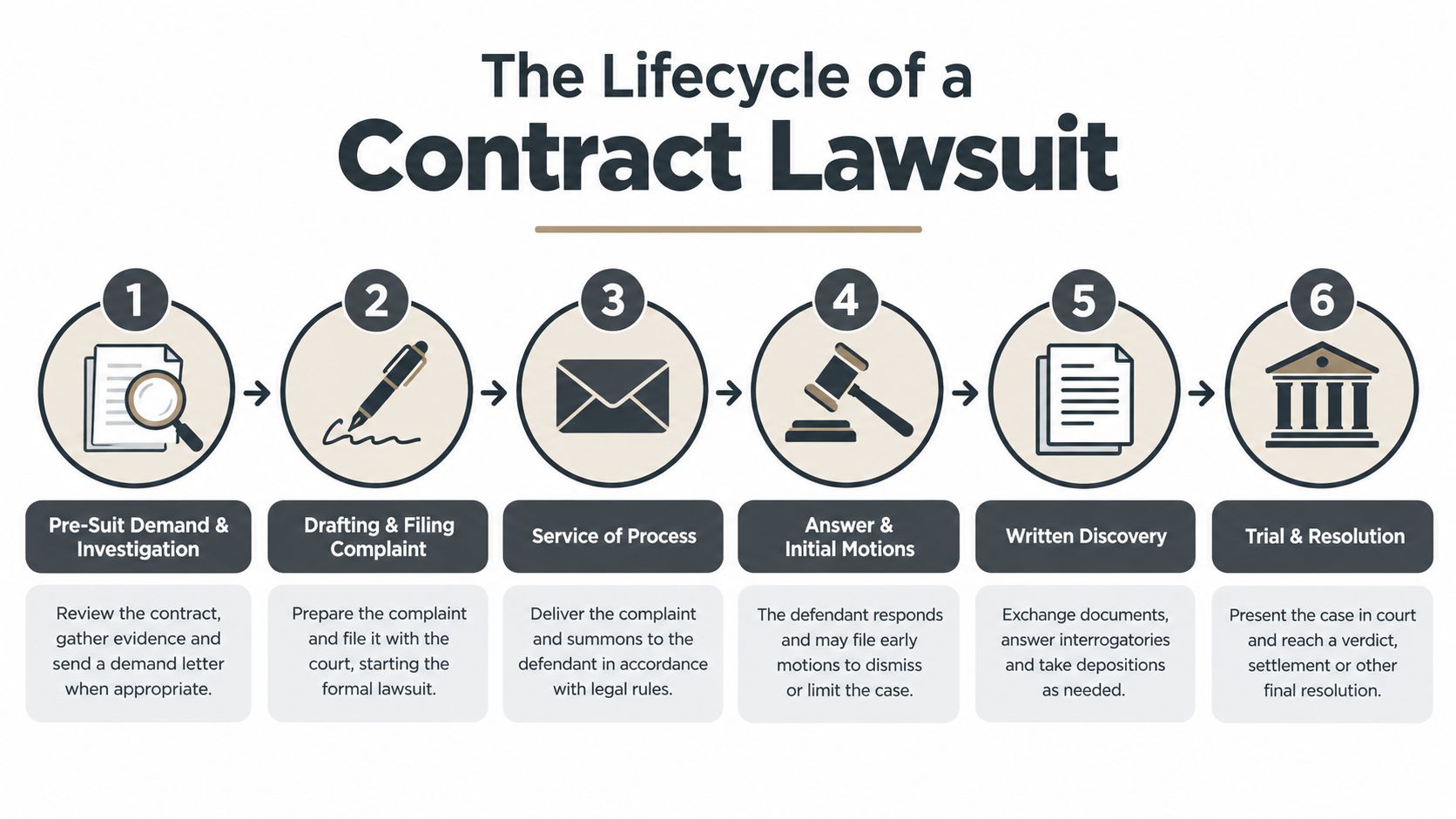
A contract case usually starts when a business owner has to make a hard call under pressure. A customer has stopped paying, a vendor missed a deadline that matters, or a former partner insists your reading of the agreement is wrong. Before anyone files suit in Connecticut or elsewhere, the useful questions are practical ones. What happened, what the contract requires, what documents exist, who will make credible witnesses, and whether the other side can satisfy a judgment if you win. A demand letter can open a real settlement discussion, expose a factual weakness, or lock in the other side's refusal to cure. A careless one can overstate the claim, invite a counterattack, or make later positions harder to defend.
Once the case is filed, the complaint sets out the parties, the court's authority to hear the dispute, the agreement at issue, the alleged breach, the damages, and the relief requested. After service, the defendant answers, raises defenses and counterclaims, and may challenge jurisdiction, venue, or the legal sufficiency of the pleadings. For an owner, this is an early decision point. Dropping a weak theory can save real money later. Pressing a narrow, provable claim often does more for settlement value than pleading every grievance the business has.
Discovery determines the shape of the case
Discovery is where many contract cases become expensive. The parties exchange written requests for contracts, emails, texts, invoices, financial records, customer materials, and other evidence. They take depositions under oath. In the right case, experts may address accounting, valuation, industry practice, technical performance, or damages. Electronic discovery can become the biggest burden when a company preserves broad data sources without first deciding which custodians, systems, and date ranges are tied to the disputed issues.
That is usually the point where strategy matters more than volume. Businesses do not win because they asked for every document. They win when discovery is tied to the few facts that will drive liability, damages, or use in settlement talks.
A disciplined plan identifies the custodians, systems, and date limits that matter, then matches discovery to the claims worth proving. It also forces a business owner to decide whether a fight over metadata, privilege logs, or marginal third-party records is worth the fees. In many cases, it is not.
Judgment is not the end
After discovery, either side may move for summary judgment on claims or defenses that can be decided without a trial. What survives goes into pretrial work, exhibits, witness preparation, motions in limine, and then trial. Even after judgment, the dispute may continue through post-trial motions, appeals, and enforcement efforts if the losing party resists payment or challenges the ruling.
Connecticut scheduling practices and docket conditions affect timing, but no court shortens the work created by a messy record or poorly organized proof. Owners who understand this sequence usually make better decisions about settlement timing, witness preparation, document preservation, and budget control. For teams formalizing contract administration roles, review this skills-first job listing for veterans as a model of the competencies such a role can require.
Settle, Arbitrate, or Try the Case
A business owner usually reaches this decision after the relationship has already broken down. Payment stopped, performance is disputed, records are incomplete, and someone is asking whether to press for a deal, file in court, or force arbitration. The right answer turns on value, urgency, evidence, remedies, and collectability. In Connecticut, those choices also carry practical consequences for scheduling, interim relief, and how much management time the dispute will consume.
Settlement often makes the most business sense when the parties still need each other in some way, as customer and vendor, referral partners, co-owners, or professionals with overlapping clients. It also deserves serious attention when fault is mixed, damages are hard to prove cleanly, or the likely cost of document work and witness preparation will eat into the expected recovery. A useful settlement does more than exchange money. It can set payment terms, define releases, protect confidentiality, impose client-contact limits, create a transition process, or revise an operating agreement. It loses value when the other side is using talks to stall, is not preserving evidence, or cannot realistically perform what it is offering.
Arbitration is often a good fit when the contract requires it, privacy matters, or the dispute would benefit from a decision-maker who regularly handles commercial or financial issues. It can also move on a faster track than court, as noted earlier, but speed is not automatic. A one-arbitrator case with focused proof is very different from a three-arbitrator case with experts, expansive document demands, and heavy motion practice. Businesses weighing forum choice should compare the practical trade-offs in alternative dispute resolution versus litigation.
Court is usually the better tool when you need strong third-party discovery, expect fights over nonparties, want broader appellate review, or may need to join additional parties who are not bound by the arbitration clause. It can also be the stronger forum when immediate injunctive relief or asset restraint is the priority. For some Connecticut businesses, that point decides the issue.

A practical forum test
Before choosing, ask four questions.
- What evidence matters most? If the documents, texts, or witnesses that will decide the case sit with banks, former employees, accountants, or other third parties, court process may offer a real advantage.
- What remedy is time-sensitive? If you need to stop misuse of confidential information, protect client relationships, or preserve assets, examine emergency relief options first.
- What can the other side pay? A favorable award or judgment has limited value if collection will be the real fight.
- How much review do you want after the decision? Arbitration usually leaves less room to challenge a bad result than court does.
Financial professionals and business owners interested in roles centered on negotiation, mediation, and dispute management may find this overview of 2026 conflict resolution jobs useful.
Realistic Timelines and What It Costs
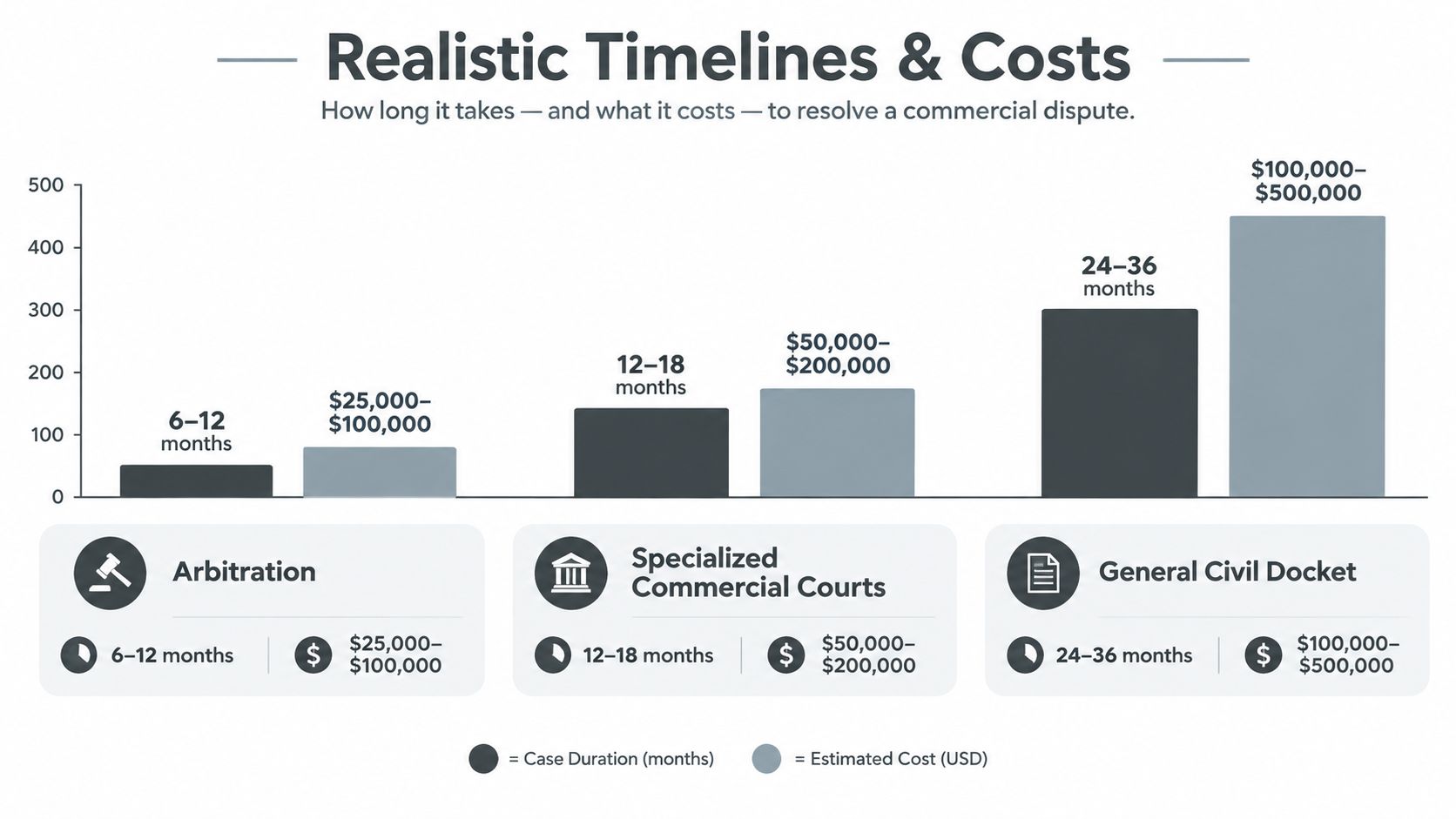
A client once asked me how long a straightforward payment dispute would take. My honest answer: a clean record and a modest claim can resolve in months, while a breakup involving compensation, client ownership, restrictive covenants, and competing accounting theories can take years even when the contract looks simple. Duration turns on the forum, claim value, number of parties, volume of electronic data, expert issues, motion practice, witness availability, and how hard the other side fights. No responsible lawyer can promise a convenient schedule.
The World Bank's contract-enforcement data measures the period from filing through actual payment, including attorney, court, and enforcement costs. Across surveyed economies, enforcement took less than 10 months in jurisdictions such as New Zealand and Norway but nearly four years in Bangladesh. Cost ranged from under 10% of claim value in Iceland, Luxembourg, and Norway to more than 80% in Burkina Faso and Zimbabwe. The same data shows what institutional reform can do: Abidjan's modeled resolution time fell from 770 days in 2011 to 585 days after creation of a specialized commercial court, and later to 525 days in the World Bank contract-enforcement data.
Those comparisons explain why a judgment is not the same as money in hand. Service, hearings, judgment issuance, asset discovery, and execution determine whether the result has economic value. A win on paper against a counterparty with hidden or encumbered assets may cost more to collect than the claim is worth.
Budget the entire path
Before filing, estimate four categories together:
- Legal work: Pleadings, motions, discovery, depositions, negotiation, and trial preparation.
- Evidence: Data collection, review, forensic accounting, valuation, and expert testimony.
- Delay: Lost management time, interrupted operations, unpaid invoices, and uncertainty.
- Enforcement: Asset location, judgment recognition, collection proceedings, and bankruptcy risk.
Run the comparison against the practical value of the claim, not the largest number that can be written into a demand. For goods disputes, timing and market evidence control the calculation. UCC § 2-713 generally looks to the difference between market price when the buyer learned of the breach and the contract price, with permitted incidental and consequential damages and saved expenses considered under the UCC damages framework. A buyer who covers may instead claim the difference between the replacement price and the original contract price, subject to applicable damages rules and commercial reasonableness as described in this analysis of cover damages.
A forum decision should therefore weigh expected spend, delay, enforcement friction, and collectability as one package. For enforcement-focused planning, businesses can also review this guide to judgment enforcement.
Contract Disputes in the Financial Services World
Financial-services disputes often combine contract language with employment facts, regulatory records, compensation statements, client relationships, and industry arbitration rules. A withheld bonus may turn on production credits, eligibility dates, discretionary language, and whether the firm communicated a change before the compensation was earned. A deferred-compensation claim may require payroll records, plan documents, amendments, and a careful limitations analysis.
A promissory-note dispute creates a different pressure point. A representative moves firms, and the former broker-dealer demands repayment of an upfront loan. The representative may challenge the balance, raise defenses based on termination or misrepresentation, or assert that the firm withheld compensation that should offset the demand. The firm, meanwhile, may pursue arbitration under an industry agreement and seek repayment before the representative can establish a new practice.
Breakup disputes need immediate evidence control
A departing advisor may take client lists, contact information, planning files, or business records and begin soliciting former clients. The firm may seek to enforce confidentiality and non-solicitation provisions, while the advisor may argue that the restrictions are overbroad or that the clients followed voluntarily. The practical dispute often turns on who accessed which system, what communications occurred, how the information was used, and whether the contract authorizes immediate relief.
Preserve email, text messages, CRM records, access logs, compensation statements, electronic files, and personal-device communications subject to applicable legal and privacy requirements. Don't wait until depositions to discover that an automatic deletion policy removed the most important records.
A FINRA arbitration may proceed alongside a court action involving related contract rights, restrictive covenants, or emergency relief. Arbitration clauses in industry agreements can direct matters to FINRA, AAA, or JAMS, but the specific clause controls. Review the scope, covered parties, available remedies, emergency procedures, and any interaction with a court filing before choosing a forum.
Limitations periods require an early classification
Compensation, employment, promissory-note, and business-breakup claims may carry different filing deadlines. Connecticut General Statutes § 52-581 provides that an action founded on an express contract or agreement that isn't reduced to a signed writing generally must be brought within three years after the right of action accrues under Connecticut General Statutes § 52-581. That rule concerns unwritten express agreements, so it doesn't answer every contract question.
The first task is to identify the agreement's form and type, the accrual event, any contractual notice requirement, and whether another statute or arbitration rule applies. A party that waits for negotiations to fail before analyzing those clocks may lose an advantage or the claim itself. Early preservation of compensation records and disputed accounting data also targets the discovery and motion-practice problems that commonly expand these matters.
Practical Steps Before You End Up in Court
Contract hygiene reduces the number of disputes that become legal emergencies. Set clear performance milestones, define acceptance criteria, require written change orders, and make amendments effective only when signed by authorized representatives. A short clause that identifies notice methods and cure periods can matter more than pages of general intent language.
Document performance while the relationship is still functioning. Keep delivery records, project files, approvals, invoices, compensation statements, meeting notes, and material communications in a system that preserves dates and authorship. For financial practices, disciplined onboarding and handoff procedures, such as those described in this resource on onboarding new clients in wealth management, can also reduce later disagreement about responsibility, records, and client ownership.
Before escalating, run this checkpoint:
- Read the forum clause: Confirm arbitration, mediation, venue, notice, and governing-law requirements.
- Calculate the claim: Separate principal, replacement costs, lost profits, offsets, fees, and uncertain damages.
- Preserve evidence: Suspend routine deletion and identify relevant custodians, systems, and devices.
- Locate assets: Determine where the counterparty operates and holds property before spending heavily on a judgment.
- Choose the objective: Decide whether you need payment, performance, protection, a negotiated exit, or a precedent.
Kons Law handles commercial disputes through negotiation, arbitration, litigation, and judgment-enforcement strategies, including matters involving contracts, compensation, partnerships, and financial professionals. If you want to discuss your business law matter, contact Kons Law at (860) 920-5181.
Kons Law can help assess the contract, evidence, forum, damages, and enforcement issues that shape a business dispute before a filing decision is made. To discuss a contract dispute litigation matter with counsel, visit Kons Law or call (860) 920-5181.
