
You're staring at a statement that once looked routine, maybe even boring, and one line has turned into a problem you can't ignore. A security you thought would behave like cash is suddenly stuck, the auction doesn't clear, and your money is trapped in something that was marketed as liquid. That's the basic confusion around auction rate securities, and it's exactly why investors, advisors, and counsel still need a clear map of how these instruments work, where they broke, and what recovery can look like afterward.
Introduction to Auction Rate Securities
A lot of investors first met auction rate securities as a convenience. The structure looked simple enough, long-term money on the issuer side, short-term rate resets on the investor side, and periodic auctions that were supposed to keep everything moving. The problem came when the auction stopped acting like a market and started acting like a lock.
That gap between what people expected and what happened is the reason ARS still matter. The mechanics explain the promise, the failure explains the damage, and the legal aftermath explains why some investors recovered while others were left in a very different position. For a reader holding a frozen position, or advising someone who is, the question is no longer abstract, it's what the instrument was, why the auction failed, and what paths remain after the freeze.
Practical rule: If a security depends on repeated auctions to stay liquid, the auction itself is part of the risk, not just a pricing detail.
Understanding Auction Rate Securities
Auction rate securities are a hybrid instrument. The issuer gets long-term funding, while the investor gets a rate that resets through periodic auctions, which is why ARS have often been described as sitting somewhere between long-term credit and cash-like holdings. The Federal Reserve Bank of Chicago's overview explains that ARS were introduced in 1984, reached about $330 billion in 2007, and commonly had maturities of 20 to 30 years with reset periods every 1 to 35 days.
That structure is what makes the product easy to misunderstand. On the surface, it can feel like a rolling short-term investment, because the rate keeps resetting. Underneath, it's often a long-dated bond or preferred equity instrument, so the investor is really holding a long-term obligation that keeps wearing a short-term mask.
How the hybrid structure works
It functions similarly to a rolling credit card balance with a rate that gets re-priced on a schedule. The balance is still there, long-term and unresolved, but the financing cost gets updated through the auction process. Another useful analogy is a ticking interest clock. The clock doesn't retire the debt, it only resets the rate.
The Investor.gov explanation of auction rate securities notes that most ARS are long-term bonds, while some are preferred equity with no stated maturity. The Congressional Research Service report also describes the same core design, long-term borrowing paired with short-term money-market style pricing through periodic auctions.
Why the reset schedule matters
The reset frequency matters because it shapes both pricing and perceived liquidity. A security that resets every week or every few weeks can feel more tradable than a bond that stays fixed for years, even when the underlying maturity is still decades away. That's why ARS were historically treated as a hybrid, not as pure long-term debt and not as true cash equivalents.
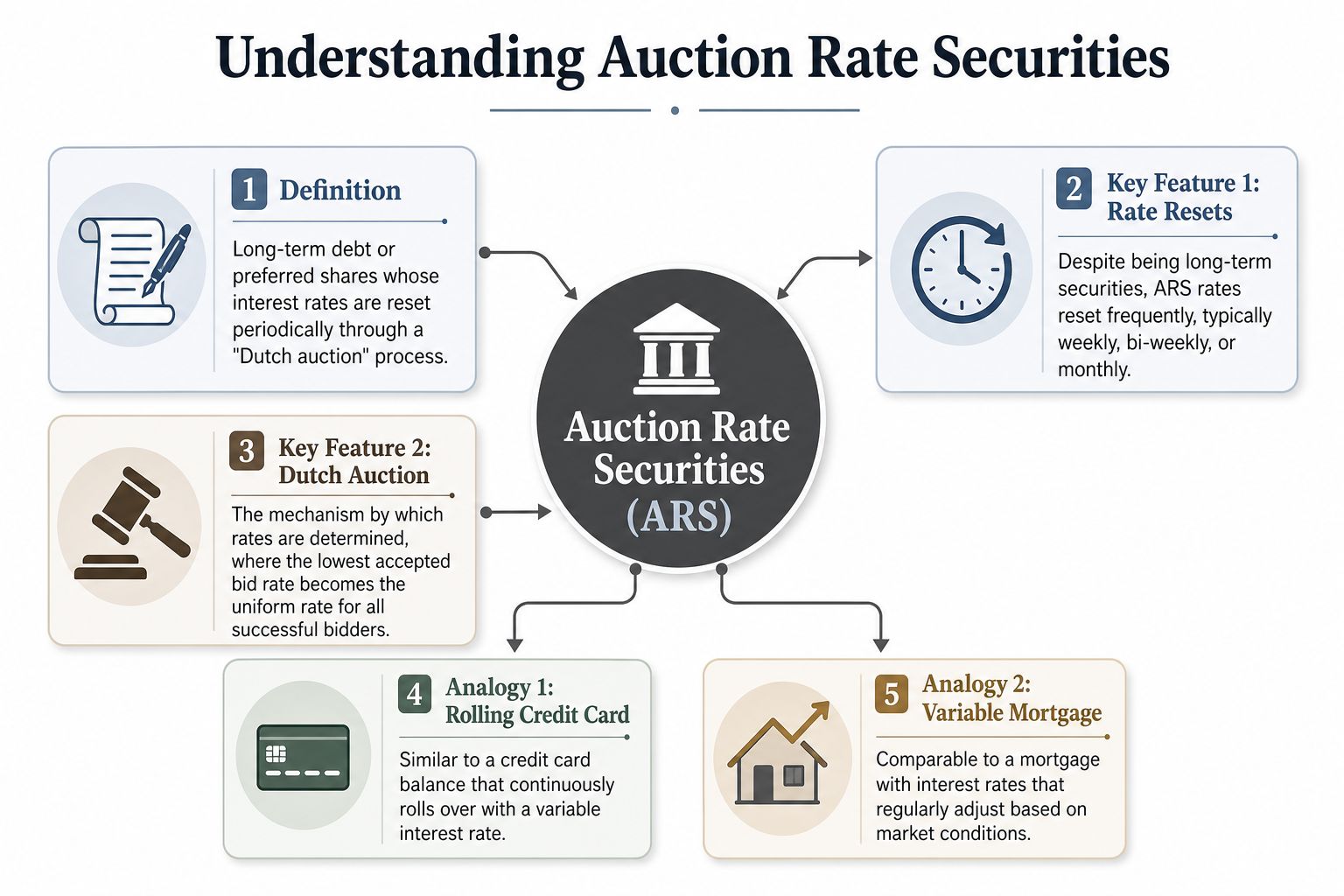
The key takeaway is simple. Short reset periods don't erase long duration, they only create the appearance of mobility. That's why the auction mechanism matters so much, and why investors often found out too late that liquidity depended on something fragile.
For more on how long-dated instruments can create default and recovery issues, see this legal guide to bonds in default.
How Auction Rate Securities Auctions Work
The auction process was designed to set a rate through buyer and seller interest, much like a market clearing system. In practice, it worked only when enough bids showed up. When demand was there, the auction reset the rate and the security kept moving. When demand dried up, the market's promise of liquidity broke down.
The auction in plain language
Investors submitted bids showing how much ARS they wanted to hold and what rate they were willing to accept. Broker-dealers collected those orders and compared them against the supply of securities up for auction. The clearing rate became the lowest rate at which the available securities could be placed.
That rate then applied uniformly to the successful bidders. If enough demand existed, holders could exit, buy, or roll their positions at the new rate. If demand was thin, the auction could fail, which meant the issue didn't clear in the normal way and holders might be stuck at a maximum or default rate.
Why clearing depends on participation
The important point is that ARS auctions weren't self-sustaining. They needed enough participation every time the auction ran. In good conditions, the auction gave issuers funding and investors a reset rate. In bad conditions, the process exposed the fact that liquidity was contingent, not guaranteed, as reflected in the auction-rate security overview on Wikipedia.
The auction is only as liquid as the bids that show up that day.
That's why the structure looked stable until it didn't. A successful auction can feel almost invisible to the holder, because the rate reset happens behind the scenes. A failed auction is much louder. It changes the investor's position from “I can exit at the next auction” to “I may have to keep holding this instrument.”
What investors often miss
The confusing part is that a failed auction doesn't always mean the credit itself has collapsed. It means the pricing and liquidity mechanism has broken down. That distinction matters because investors often assumed they were buying something closer to a money-market product, when the underlying instrument was still a long-term obligation.
In legal disputes, that misunderstanding becomes central. Counsel often has to examine the auction records, the disclosures, and the role of the dealer support that kept the process running. If the mechanics weren't properly explained, the investor may have been sold liquidity that didn't really exist.
Historical Market Freeze of 2008
By early 2008, the weakness in the ARS model stopped being theoretical. Auctions began failing on a wide scale in February 2008, and a market that had looked orderly on paper suddenly became illiquid in practice. Reuters reported that roughly half of the $330 billion market was issued by U.S. states, municipalities, and public authorities, with the rest spread across closed-end funds, corporations, and student-loan agencies, and later broker-dealers agreed to repurchase about $50 billion of ARS from investors as part of settlements.
How the freeze unfolded
The sequence started with growing caution in financial markets, then moved into repeated auction failures. Once dealers stepped back from supporting auctions, many issues no longer attracted enough bids to clear. Investors who expected routine resets found themselves holding securities that would not sell at par, and in many cases would not sell at all on the terms they expected.
The Reuters factbox on auction rate securities captures the scale of the event, but the practical lesson was straightforward. Holders who treated the product as liquid learned that the liquidity depended on continued participation. Issuers that had relied on the market faced a financing problem, and investors had to sort through both the financial damage and the legal questions.
The collapse also followed the pattern of a sudden market break, where confidence can disappear faster than anyone expects. For a useful way to understand that kind of shock, the guide to managing market anomalies helps explain how a product can appear stable until the market stops cooperating.
Who was hit hardest
Municipalities and public authorities made up a large portion of the market, so the freeze affected public finance as well as private portfolios. The shock reached different issuer types in different ways. The market retrospective in the SLCG ARS paper is better used later, when investors are comparing recovery paths, because the immediate lesson here is that the freeze did not hit every holder in the same way.
That difference matters once investors start thinking about legal recovery. It changes how damages are evaluated, what a holder may still own, and which claims are stronger. It also explains why some investors recovered through settlements while others had to pursue a more individualized path.
Identifying Risks and Red Flags
The first warning sign in ARS often sat in plain sight. The whole structure depended on an auction finding enough buyers to clear. If that participation thinned out, the product could stop behaving like a cash substitute and start acting like an illiquid holding that investors did not expect to keep.
What to watch for before buying
A careful review starts with the issuer type, the auction support structure, and the disclosure language. A municipal issue, a corporate issue, a fund-related issue, and a structured vehicle can carry very different risk profiles, even if they all sit under the ARS label. A product tied to a layered structure deserves closer scrutiny because the auction mechanics are only part of the story.
Dealer support is another point to examine. If the market relies on broker-dealers stepping in to keep auctions moving, the investor should ask what happens if that support disappears. Credit quality matters too. Even if the auction process still functions, weakening issuer credit can reduce the value of the security and make recovery more difficult later.
Red flags investors should ask about
- Auction dependency: Ask whether the issue can still function if dealer support disappears.
- Issuer quality: Review whether the issuer is a municipality, corporation, fund, or structured vehicle.
- Structure complexity: Treat CDO-linked or similarly layered products as harder to evaluate than plain municipal issues.
- Disclosure clarity: Look for plain-language explanations of failed auction consequences, not marketing language.
- Exit assumptions: Confirm whether the investor was told liquidity was routine, certain, or effectively guaranteed.
The question is often whether the investor was led to believe the product was safer and more liquid than it really was. A short reset period can make the instrument look stable on paper, the way a car can look dependable if you only check the dashboard and never the fuel gauge. The central issue is whether the disclosure explained what happens when the auction does not clear, because that is where securities fraud concerns can begin to matter.
The point is not that every ARS offering was improper. The point is that the product could be misunderstood very easily, especially when advisers or broker-dealers emphasized liquidity and rate resets without explaining the failure scenario. That is the moment when investor confusion can become a legal issue.
Navigating Regulatory and Legal Issues
After the market froze, investors were often left with two separate questions. One was what regulators and broker-dealers did in response, through settlements, repurchase programs, and disclosure reviews. The other was how an individual investor could still seek recovery when those broader remedies did not fully address the loss. For many holders, a key question was whether the problem should be treated as a disclosure failure, a sales-practice problem, or a dispute that needed a formal claim.
Why the recovery path is not one-size-fits-all
Recovery paths varied because the products themselves varied. Municipal ARS and structured-finance ARS did not behave the same way once the auctions stopped functioning, and that difference shaped both value and legal strategy. The SLCG paper explains that the market did not unwind evenly, which is why a claim tied to one kind of ARS may not fit another.
That is similar to repairing two cars with different engines. A mechanic would not use the same fix for both, even if both fail to start. In the same way, counsel has to match the recovery strategy to the issuer, the structure, and the sales facts. A municipal issue sold to a retail investor raises different questions from a complex structured product sold with thin disclosure.
Regulatory investigations often focus on whether the disclosure explained liquidity limits clearly, whether the auction process was described accurately, and whether broker-dealers overstated how safe the product was. If the security was presented as if cash access were routine when that was not true, the record may support arbitration or litigation theories based on misrepresentation or an unsuitable recommendation. For a closer look at how these matters are handled at the firm level, this SEC investigations resource gives useful background.
What investors should document
Before a claim moves forward, investors should gather the auction confirmations, account statements, offering documents, and any emails or notes from the sales process. The auction history matters because it shows whether the investor was repeatedly told the product was liquid, what changed when auctions failed, and how the position was later treated. Those records also help counsel decide whether a FINRA arbitration, an AAA claim, or a court filing is the better path.
The forum choice matters because each route has different procedures, evidence expectations, and timing issues. Arbitration is often more focused on investor losses, while litigation can allow broader discovery in the right case. The right choice depends on the client's posture, the size of the position, and the proof available.
Bottom line: Recovery turns on the record. If the sales materials, auction records, and dealer communications are not organized early, the strongest argument can lose force over time.
The best approach is step by step. First, identify the sales story. Then compare it with the auction record. Then test whether the facts support a regulatory complaint, an arbitration claim, or a settlement discussion. That method matters because ARS cases often turn on what the investor was told before the market froze, not only on what happened afterward.
Next Steps for Investors and Advisors
Start with a portfolio audit. Identify every ARS position, the issuer type, the auction dates, and whether any auctions failed. Then pull the sales documents and note whether the product was described as liquid, conservative, or cash-like, because those words often become important later.
A simple action plan
- Collect the record: Save statements, confirmations, offering documents, and advisor emails.
- Map the auction history: Note when the auctions cleared and when they didn't.
- Review the disclosures: Compare what was promised with what the documents said.
- Assess the forum: Determine whether your dispute fits FINRA arbitration, another arbitration forum, or court.
- Get legal guidance early: Timing and evidence matter, especially if you're dealing with advisor misconduct or Form U5 issues alongside the investment loss.
For process-level context, this FINRA arbitration guide can help you understand the general path before you file.
Advisors should also document their supervisory records and communications, because the recovery analysis can overlap with employment and compliance issues. If there's a parallel dispute with a broker-dealer, counsel may need to separate the investor claim from any advisor defense or termination matter. That's where a business-focused law firm can help sort the facts into the right procedural lanes, including Kons Law.
If you want to discuss your business law matter, contact Kons Law at (860) 920-5181.
A CTA for Kons Law.
